
Annotate
Annotate by xAnnotate lets you record your screen, point, and speak to create video prompts for AI tools like Cursor, Claude, and Codex. It’s local-only, free, and simplifies handing off visual contex
What is Annotate?
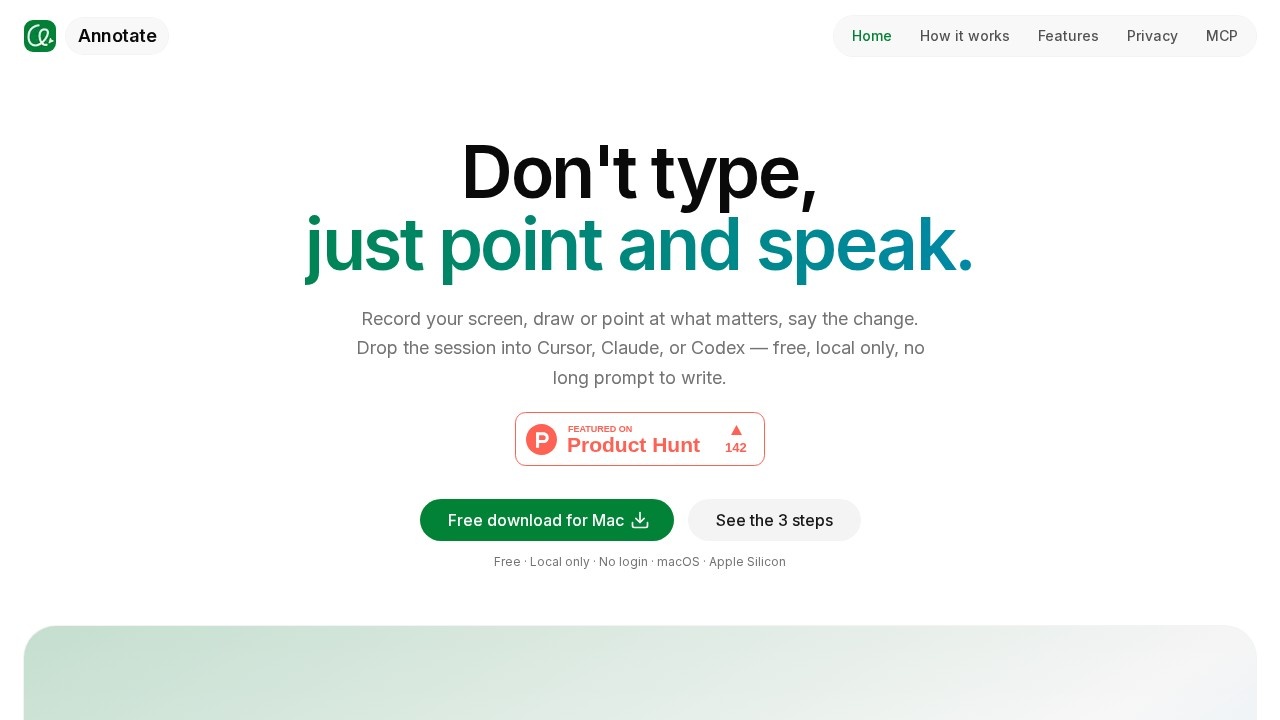
Annotate is a free, local-only macOS app that replaces written AI prompts with recorded screen walkthroughs. Instead of typing a long brief for Cursor, Claude Code, or Codex, you record your screen, draw or point at the exact UI element, and speak the change you want. The app captures frames, gestures, and your transcribed voice in sync, then hands the session off to your agent of choice. Everything stays on your Mac—nothing is uploaded, and no login is required.
Application scenarios
UI bug fixes
Point at a broken button, say what's wrong, and let the agent read the recording instead of a vague screenshot.
Design tweaks
Draw a rectangle around an element and say "make this button match the sidebar colour" for precise visual changes.
Multi-monitor workflows
Capture your app on one display and your editor on the other in a single session, so the agent sees the full context.
Code refactoring
Talk through a change while showing the relevant files, and let Cursor or Codex act on the synced frames and speech.
Onboarding handoffs
Record a quick walkthrough of a task you'd normally explain in a long Slack message, then drop it into Claude Code.
Complex state changes
Show clicks and timing that a static screenshot can't convey, so the agent follows the actual sequence of actions.
Core Features
Screen recording
Capture one window or every display in a single session.
Point and speak
Draw in the UI with pen, rectangle, or text tools, and say what you want changed—no written brief needed.
Agent handoff
Open the recorded session directly in Cursor, Claude Code, or Codex without switching to a new chat app.
MCP-based reading
The agent reads frames and speech via MCP, not a giant video dump, which means fewer tokens and clearer intent.
Voice transcription alignment
Your speech is transcribed and lined up with what was on screen at the moment you said it.
Multi-monitor capture
Record the app on one display and your editor on another together in one take.
Local-only storage
Frames and transcripts live on your Mac and are never uploaded to a server.
No login required
Download and use it immediately without creating an account.
Target users
Annotate is built for developers and technical users who work with AI coding agents like Cursor, Claude Code, and Codex. It's especially useful for anyone who finds writing detailed prompts tedious or imprecise—frontend developers describing UI changes, engineers debugging visual issues, and teams that need to hand off context quickly without typing long explanations. Since it's free and local-only, it also suits privacy-conscious users who don't want their screen content leaving their machine.
How to use Annotate?
The process is three steps, as described on the site:
- Record your screen: Capture one window or every display in a single session.
- Point and speak: Draw in the UI and say what you want changed—skip the written brief.
- Hand off to your agent: Open the session in Cursor, Claude, or Codex and let it take the next step.
The app is a free download for Mac with Apple Silicon (arm64). No sign-up or login is needed.
Pricing and free trial
Annotate is free. The site states "Free · Local only · No login" and offers a free download for Mac. There is no mention of paid tiers or trial periods.
Effect review
Annotate directly addresses a real pain point: translating visual intent into text prompts for AI agents. The combination of screen recording, drawing tools, and voice transcription that stays in sync with frames is a practical improvement over static screenshots, which lose clicks, timing, and spoken context. The local-only design is a strong trust signal, especially for developers working with proprietary code. The MCP-based approach to feeding the agent frames and speech rather than a video file is also smart—it keeps token usage low while preserving intent. For anyone already using Cursor, Claude Code, or Codex, this could meaningfully cut the time spent writing and revising prompts. The main limitation is platform scope: it's macOS and Apple Silicon only, so Windows or Intel Mac users are out of luck for now.
Frequently Asked Questions
What is Annotate?
How does Annotate work?
Is Annotate free to use?
Does Annotate store my recordings in the cloud?
Which AI tools are compatible with Annotate?
Why should I use Annotate instead of typing prompts?
Annotate - AI Tool Detail
Annotate by xAnnotate lets you record your screen, point, and speak to create video prompts for AI tools like Cursor, Claude, and Codex. It’s local-only, free, and simplifies handing off visual contex
Category:Video editing
Visit Link:https://xannotate.com/
Tags:screen recording、video prompts、AI coding tools、visual context、local privacy