
Saneops
Saneops is a self-hosted AIOps platform that correlates and deduplicates alerts from Grafana, Datadog, and PagerDuty, generates first-draft RCAs with LLMs, and cuts alert volume reaching humans by ~80
What is Saneops?
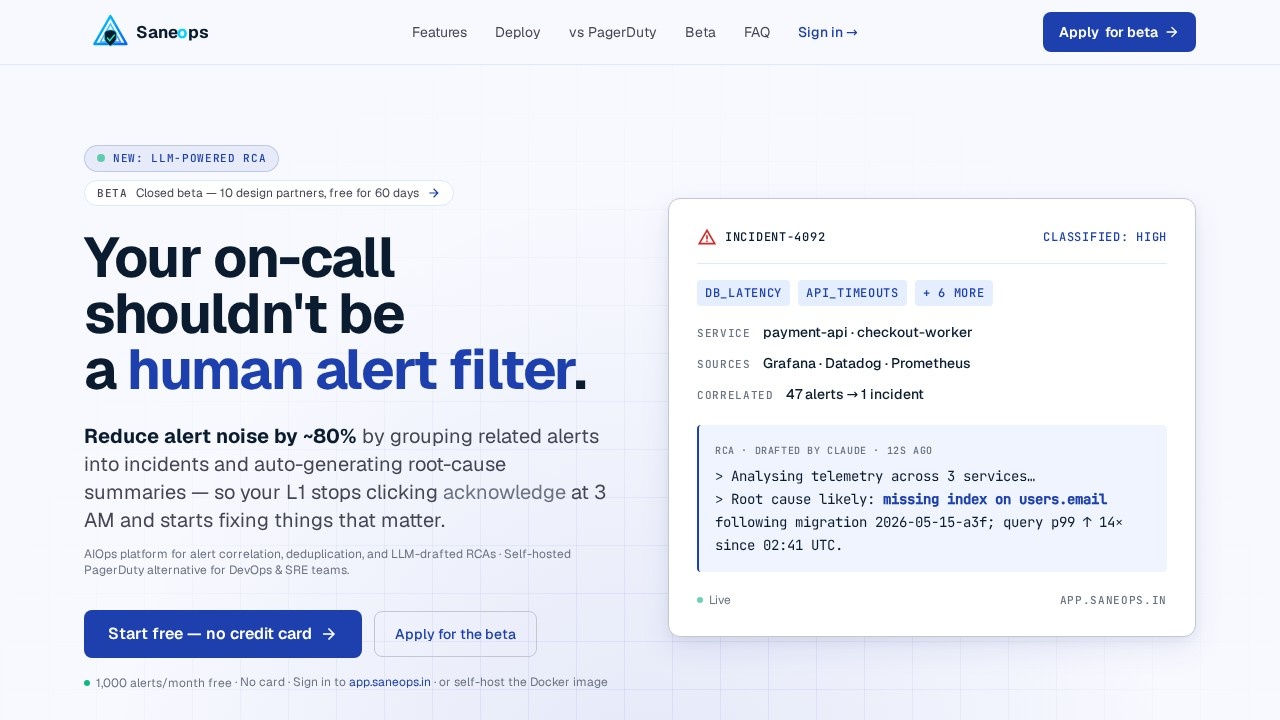
Saneops is a self-hosted AIOps platform designed to reduce alert noise by ~80% by grouping related alerts into incidents and auto-generating root-cause summaries. It correlates and deduplicates alerts from tools like Grafana, Datadog, Prometheus, and PagerDuty, then drafts RCAs using LLMs like Claude. The platform acts as a self-hosted PagerDuty alternative for DevOps and SRE teams, aiming to replace manual alert filtering with automated incident management.Application scenarios
NOC and on-call operations
Reduces alert volume reaching humans by ~80%, so L1 engineers stop clicking acknowledge and start fixing issues.
Multi-source alert correlation
Collapses related symptoms from services like payment-api and checkout-worker into a single incident, cutting duplicates from multiple monitoring tools.
Root cause analysis
Auto-generates first-draft RCAs (e.g., "missing index on users.email following migration") within seconds, accelerating triage.
Incident management for SRE teams
Provides a live dashboard showing correlated incidents, open incidents, and active incidents with severity levels (P1, P2, P3).
Self-hosted compliance
Deployed on-premises via Docker image, aligned with DPDP/GDPR data privacy requirements.
Beta testing for LLM-powered RCA
Closed beta with 10 design partners, offering 60 days free for early adopters.
Core Features
Alert correlation and deduplication
Automatically groups 47 alerts from multiple sources into one incident, reducing noise by ~92% in beta tenants.
LLM-drafted root cause analysis (RCA)
Uses Claude to analyze telemetry across services and generate a root-cause summary (e.g., "query p99 ↑ 14× since 02:41 UTC").
Multi-source webhook ingestion
Supports Grafana, Datadog, PagerDuty, Prometheus, and custom JSON alert sources via webhook.
Self-hosted deployment
Runs via Docker image, giving teams full control over data and compliance.
Live incident dashboard
Displays real-time metrics like alerts ingested, incidents total, open incidents, and active incidents with severity labels.
~80% noise reduction
Cuts alert volume reaching humans, with internal testing verifying 10,000+ alerts/day.
< 1 minute L1 triage time
Auto-gathered context enables faster first response, compressing MTTR by 4x.
Zero wake-ups for noise
Only actionable incidents page human on-call engineers, eliminating false alarms.
Target users
DevOps and SRE teams running 24/7 NOC or on-call rotations who deal with high alert volumes (e.g., 800 alerts/day, 90% noise). Also suitable for organizations needing self-hosted, DPDP/GDPR-aligned alert management—especially teams currently burning $400K/year on a 4-engineer NOC team mostly triaging duplicates.How to use Saneops?
Start by signing in at app.saneops.in or self-hosting the Docker image. Point any alert source (Grafana, Datadog, PagerDuty, Prometheus, custom JSON) at Saneops via webhook. The platform automatically ingests alerts, correlates related symptoms into incidents, and drafts RCAs using LLMs. For the beta, apply for the closed beta (10 design partners, 60 days free) to test LLM-powered RCA.Pricing and free trial
Saneops offers a free tier with 1,000 alerts/month, no credit card required. The closed beta for LLM-powered RCA is free for 60 days. For self-hosted deployment, the Docker image is available with no upfront cost mentioned.Effect review
Beta tenant data shows real results: 92% alert compression, 4x faster MTTR, and zero wake-ups for noise. The live dashboard at app.saneops.in demonstrates 847 alerts compressed into 12 actionable incidents, with RCAs generated in seconds by Claude. Internal testing verified handling 10,000+ alerts/day. The platform's self-hosted nature and DPDP/GDPR alignment make it practical for compliance-conscious teams. While still in open beta, the numbers suggest it can meaningfully reduce on-call burnout and operational costs for NOC teams.Frequently Asked Questions
What is Saneops?
Which monitoring tools does Saneops integrate with?
How does Saneops reduce alert volume?
Does Saneops generate root cause analysis?
Is Saneops a cloud or self-hosted solution?
Who is Saneops designed for?
Saneops - AI Tool Detail
Saneops is a self-hosted AIOps platform that correlates and deduplicates alerts from Grafana, Datadog, and PagerDuty, generates first-draft RCAs with LLMs, and cuts alert volume reaching humans by ~80
Category:Automation
Visit Link:https://saneops.in/
Tags:self-hosted AIOps、alert correlation、RCA generation、incident management、observability