
Invariance
AI-native observability tool by Invariance that monitors systems autonomously. It ingests logs, agent runs, and errors, detects drift, and provides exact code fixes for your coding agent.
What is Invariance?
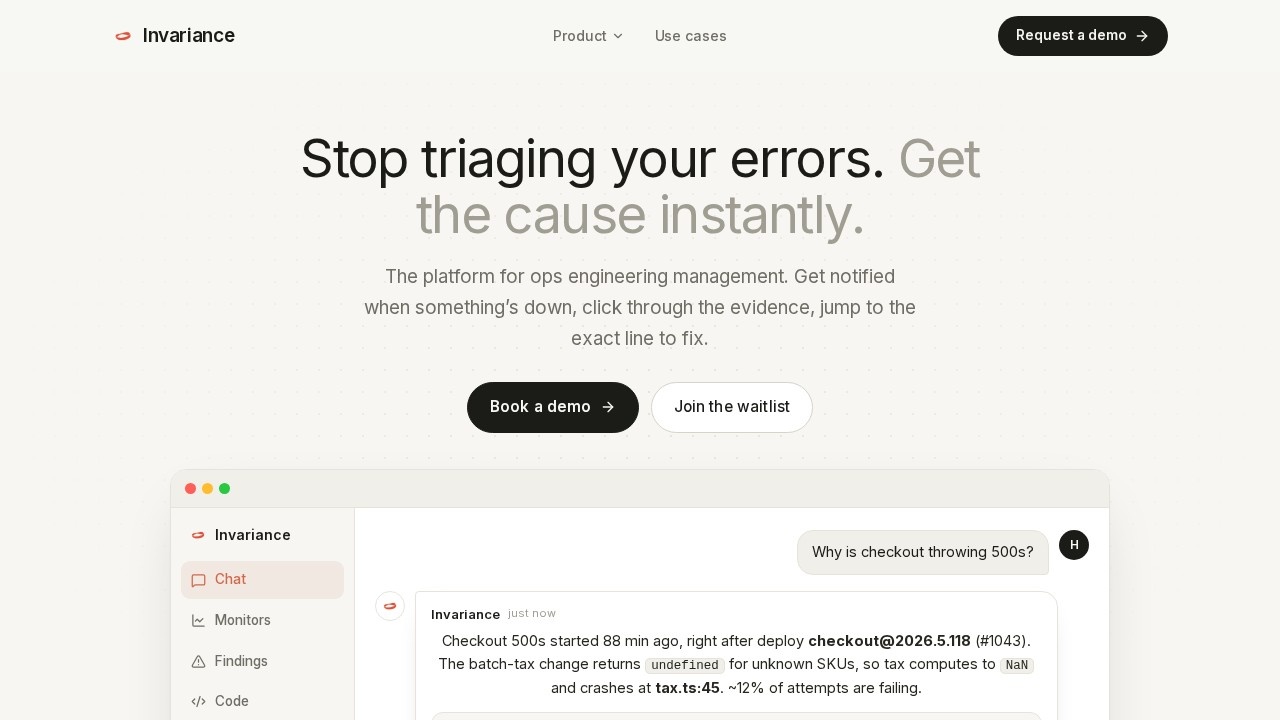
Invariance is an AI-native observability platform that monitors your systems autonomously. It ingests logs, agent runs, and errors, detects drift from normal baselines, and provides exact code fixes for your coding agent. Instead of just alerting you to problems, it creates a "finding" with the full case attached—what broke, which deploy caused it, who owns it, and where in the code to look. Users point it at their stack, and the AI agent (named "Soma") watches systems 24/7, correlates spikes to specific deploys and code lines, and drafts guarded changes ready for review.Application scenarios
Production error triage
When checkout throws 500s, Invariance instantly identifies the root cause (e.g., unchecked tax-rate access at tax.ts:45) and links it to the deploy that caused it (#1043).
Deploy monitoring
After a new deploy, the platform detects metric drift (e.g., error rate jumps from 1.2% to 8.4%) and correlates it to the offending code change.
Coding agent handoff
A guarded fix is drafted at the exact line of code, ready for your coding agent to merge—no manual digging through logs.
Incident tracking
Every finding is tracked, assigned, and linked to its evidence, so nothing falls through the cracks.
Knowledge base queries
Ask in plain language and Soma answers from a grounded graph of your Slack, GitHub, Granola, Sentry, and more, with citations.
Multi-system observability
Monitors multiple systems (e.g., checkout, payments) simultaneously, with a dashboard showing health status and open findings.
Core Features
Autonomous monitoring (Soma)
Learns the baseline for every system and watches it around the clock without requiring threshold tuning.
Drift detection
The moment a metric drifts past normal, the monitor fires automatically.
Root cause investigation
Correlates error spikes to the specific deploy, offending code, and owner.
Finding creation
Automatically opens a finding with the full case attached—what broke, which deploy, who owns it, and where in the code to look.
Guarded fix drafting
Identifies the suspect line and drafts a guarded change ready to hand to your coding agent.
Evidence linking
Every finding is tracked, assigned, and linked to its evidence (e.g., Sentry events, deploy IDs, code lines).
Plain-language querying
Ask anything in natural language and Soma answers from a unified graph of your company’s tools (Slack, GitHub, Granola, Sentry, etc.).
Real-time dashboard
Shows system health, error rates, and open findings in a single view.
Target users
- DevOps and SRE teams who need to stop triaging errors manually and get the cause instantly.
- Engineering managers who want to reduce mean time to resolution (MTTR) by automating investigation and fix drafting.
- Software engineers who deploy frequently and need immediate visibility into production issues.
- Platform engineering teams looking for an AI-native observability layer that integrates with existing tools (Sentry, GitHub, Slack, etc.).
How to use Invariance?
- Point it at your stack: Connect Invariance to your systems (logs, agents, error trackers).
- Let Soma learn: The AI watches your systems 24/7 and establishes baselines for normal behavior.
- Receive findings: When something breaks, Soma opens a finding with the full case attached—no manual investigation needed.
- Review the fix: A guarded change is drafted at the exact line of code; review it in your GitHub pull request.
- Ship and track: Approve the fix, ship it, and track all findings in the dashboard.
- Ask anything: Use plain-language queries to get answers from your company’s knowledge graph.
Effect review
Invariance delivers on its promise to stop triaging errors and get the cause instantly. The demo shows a real-world scenario where a checkout 500s spike is traced to a specific deploy, code line, and owner—with a fix already drafted. The autonomous monitoring and drift detection eliminate the need for manual threshold tuning, which is a significant time-saver. The "finding" approach (not just an alert but a full case with evidence) is a clear upgrade over traditional alerting tools. For teams already using Sentry, GitHub, and Slack, the integration into a single grounded graph makes it practical. While the platform is still in waitlist mode, the feature set suggests it could dramatically reduce incident response time for ops-heavy engineering teams.Frequently Asked Questions
What is Invariance?
How does Invariance detect issues?
Can Invariance automatically fix problems?
What types of data does Invariance monitor?
Is Invariance suitable for production environments?
Invariance - AI Tool Detail
AI-native observability tool by Invariance that monitors systems autonomously. It ingests logs, agent runs, and errors, detects drift, and provides exact code fixes for your coding agent.
Category:Programming Assistant
Visit Link:https://useinvariance.com/
Tags:observability、AI monitoring、drift detection、code fixes、automation