agentOS
A virtual operating system for AI agents by agentOS, providing execution, filesystem, orchestration, and apps in one lightweight library.
What is agentOS?
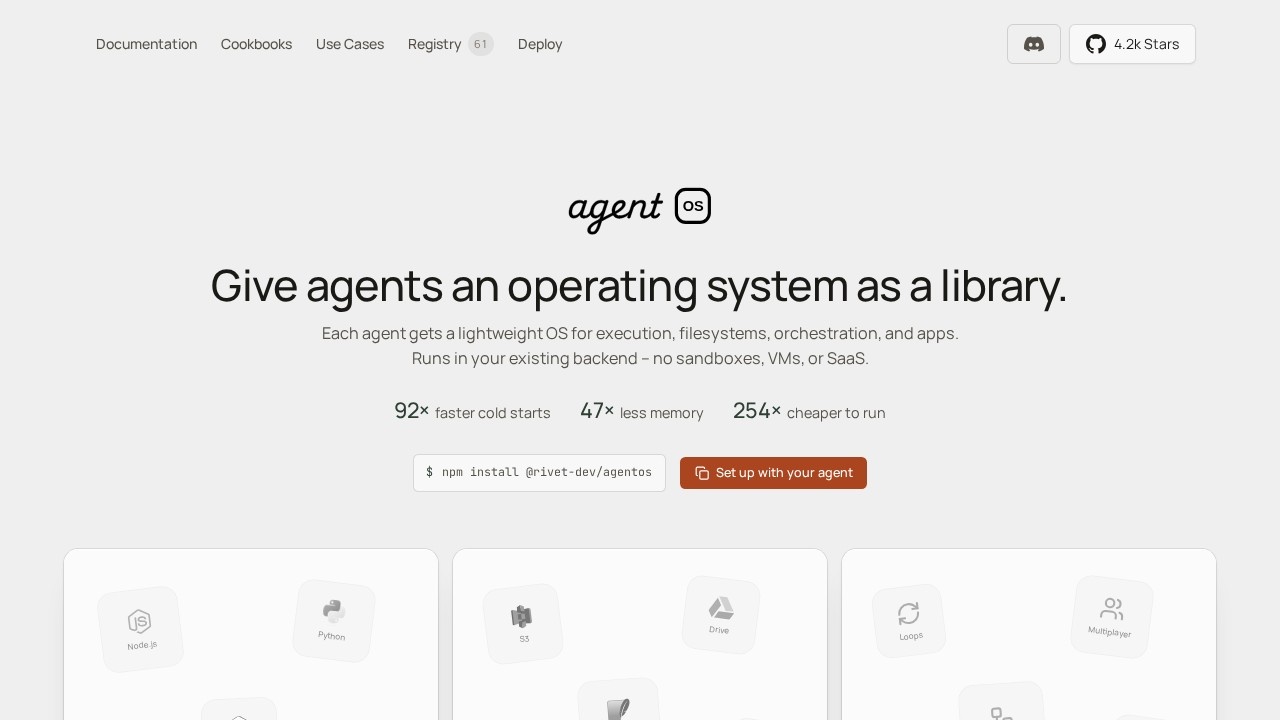
agentOS is a lightweight virtual operating system for AI agents, delivered as a library that runs inside your existing backend. It provides each agent with its own execution environment, filesystem, orchestration, and apps without requiring sandboxes, VMs, or SaaS infrastructure. Developers use it to run AI agents with dramatically faster cold starts (4.8 ms vs 440 ms), less memory (22 MB vs 1024 MB per instance), and lower cost ($0.000000073/s vs $0.09/s per execution-second). It's powered by WebAssembly and V8 isolates—the same technology behind Chrome and Cloudflare Workers.Application scenarios
Multi-agent orchestration
Run Pi, Claude Code, Codex, and OpenCode on the same virtual OS with native Rivet orchestration and integrations for Eve and Flue.
Durable file storage
Mount S3, Drive, SQLite, or HostFiles as normal files for agents to read and write.
Custom agent development
Build your own agent framework and run it alongside existing ones on the same lightweight runtime.
AI-generated application deployment
Deploy AI-generated applications for each of your users directly from the agent OS.
High-concurrency agent workloads
Run 100,000 concurrent executions on a single server with minimal memory overhead (22 MB per instance).
Security-sensitive agent execution
Use battle-tested V8 isolates and WebAssembly sandboxes for running untrusted agent code in-process.
Core Features
Execution
Run the language and tools each task needs—Python, Node.js, Bash, or any other runtime.
Filesystem
Mount durable and remote storage (S3, Drive, SQLite, HostFiles) as normal files for agents.
Orchestration
Compose modern agent patterns like loops, multiplayer workflows, and agent-to-agent communication in code.
Apps
Deploy AI-generated applications for each of your users directly from the agent OS.
Tiny runtime
Each agent gets a lightweight OS that runs in-process with no VM boot, network hop, or disk image.
Linux-compatible
Full POSIX support for files, processes, and networking.
Library-based deployment
Install agentOS from npm and run it inside your existing backend process—no extra infrastructure.
Direct function calls
Connect agents to your application with direct function calls instead of extra APIs.
Target users
This tool is for backend developers, AI engineers, and platform teams who build multi-agent systems or deploy AI agents at scale. It's ideal for teams running agent frameworks like Pi, Claude Code, Codex, or OpenCode who want to eliminate sandbox overhead and reduce infrastructure costs. Devops engineers will appreciate the in-process execution model that avoids VM provisioning and network hops.How to use agentOS?
Install the library via npm:npm install @rivet-dev/agentos. Set up your agent using Node.js, Python, or Bash. The library runs inside your existing backend process—no sandboxes, VMs, or SaaS accounts required. For orchestration, use Rivet's native agent patterns (loops, multiplayer, agent-to-agent). Visit the official website at https://agentos-sdk.dev/ for full setup documentation and methodology reproduction details.Effect review
agentOS delivers on its promise of dramatically faster cold starts (4.8 ms vs 440 ms for sandboxes) and 254× cost reduction per execution-second, backed by reproducible benchmarks. The in-process execution model using WebAssembly and V8 isolates is a clever architectural choice that eliminates the overhead of traditional sandbox solutions. Real-world teams running multiple agent frameworks (Pi, Claude Code, Codex, OpenCode) will appreciate the unified orchestration layer and direct function call integration. The library-based approach means no additional infrastructure to manage, which is a significant operational advantage for production deployments. However, the product is still relatively new and the ecosystem of supported tools may expand over time. Overall, it's a compelling option for teams looking to run AI agents at scale without the cost and complexity of sandbox providers.Frequently Asked Questions
What is agentOS?
What are the key features of agentOS?
Is agentOS open source?
How does agentOS handle orchestration?
Can agentOS run on any platform?
What programming languages does agentOS support?
agentOS - AI Tool Detail
A virtual operating system for AI agents by agentOS, providing execution, filesystem, orchestration, and apps in one lightweight library.
Category:Multi-agent collaboration
Visit Link:https://agentos-sdk.dev/
Tags:AI agents、agent orchestration、virtual OS、agent development、AI agent framework