
OpenFang
Open-source Agent OS by OpenFang, built in Rust. Features 7 autonomous Hands, 53 tools, and 16 security systems for automated workflows, with support for multiple LLM providers and a WASM sandbox.
What is OpenFang?
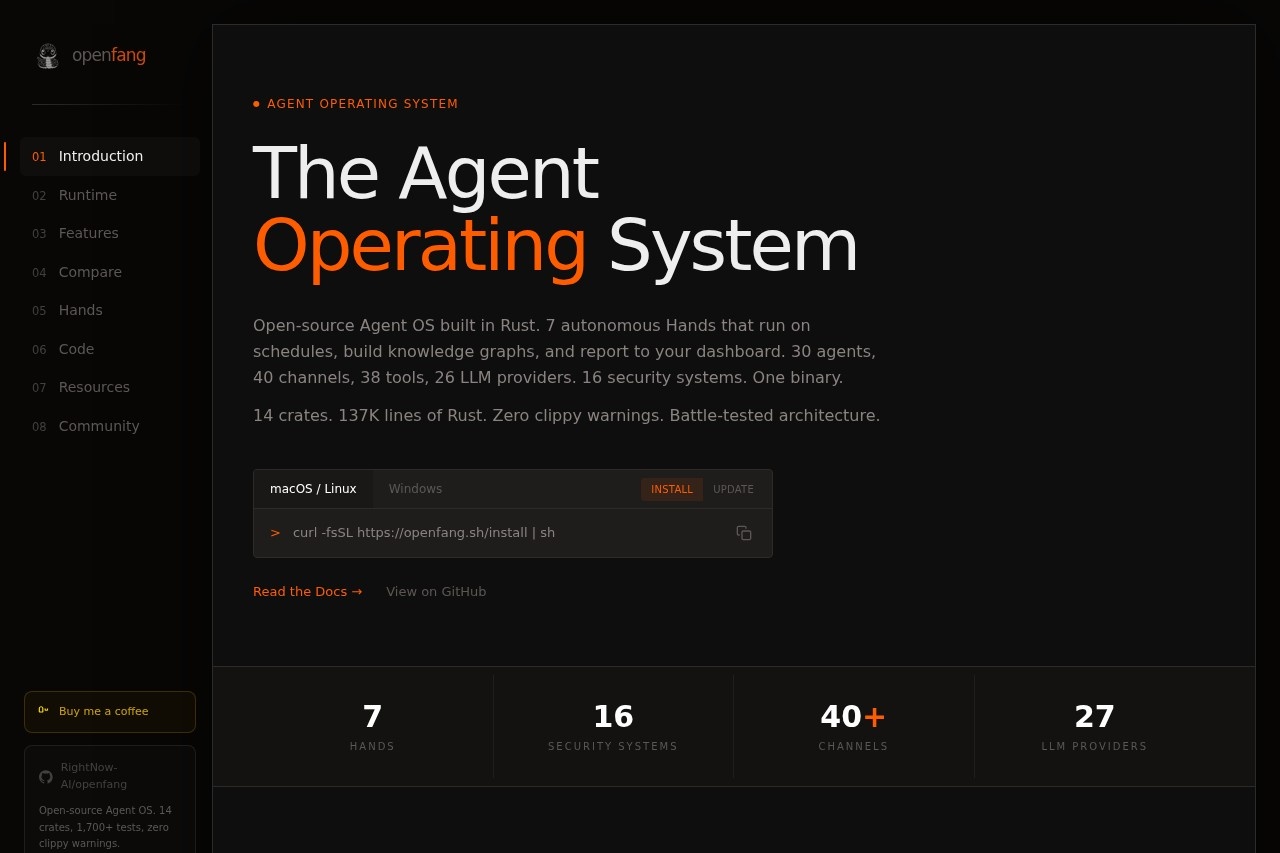
OpenFang is an open-source Agent Operating System built in Rust. It provides the core primitives for building, running, and deploying autonomous AI agents. Users install it as a single binary to automate complex workflows across communication channels, data analysis, and web tasks. The system is managed through a native desktop dashboard where autonomous components, called Hands, report their activity.Application scenarios
Social media management
Automate posting and interaction on platforms like X (Twitter).
Lead generation
Build autonomous workflows to identify and qualify potential sales leads.
Market research
Monitor targets, collect data, and perform automated fact-checking.
Content repurposing
Transform long-form video content into short clips automatically.
Customer support
Deploy agents across platforms like Telegram, Discord, and Slack to handle inquiries.
Forecasting & analysis
Run predictive models and generate performance scores like Brier scores.
Web automation
Control browser sessions to automate repetitive online tasks and data gathering.
Core Features
Autonomous Hands
Activate and configure seven pre-built capability packages that run on schedules and report to a central dashboard.
Sandboxed Runtime
Execute tool code inside a secure WASM environment with dual metering (fuel and epoch interruption) and confined file operations.
Extensive Toolset
Access 38 built-in tools and a Model Context Protocol (MCP) client/server for capabilities like web search, browser automation, image generation, and Docker management.
Multi-Platform Channels
Connect agents to 40 communication channels including Telegram, Discord, Slack, WhatsApp, and Teams with per-channel policies.
Persistent Memory
Enable agents to recall context using SQLite-backed storage with vector embeddings and automatic LLM-based session compaction.
Native Desktop App
Manage everything through a Tauri 2.0 application with system tray integration, notifications, and global shortcuts.
Comprehensive Security
Operate with 16 integrated systems including a WASM sandbox, Ed25519 manifest signing, Merkle audit trails, and prompt injection scanning.
Multi-LLM Support
Spawn from 30 pre-built agents that can utilize models from 26 different providers across four performance tiers.
Peer-to-Peer Networking
Enable agent communication using the OpenFang Protocol with HMAC-SHA256 mutual authentication.
Target users
This tool is built for developers and technical teams building and orchestrating autonomous AI agent systems. It benefits DevOps engineers focused on secure, deployable agent runtimes, product teams automating multi-channel customer interactions, and data teams creating automated research and forecasting pipelines. Its architecture appeals to those requiring production-grade security and performance from an open-source platform.How to use OpenFang?
You can install OpenFang via a command-line script:curl -fsSL https://openfang.sh/install | sh. Once installed, you interact with it via commands (e.g., $openfang compare --all) and configure the pre-built Hands and agents through the provided native desktop application. The dashboard within the app serves as the central hub for monitoring autonomous workflows and checking system status. For detailed setup and configuration, refer to the official documentation.Effect Review
OpenFang presents a comprehensive and architecturally serious framework for autonomous agent deployment. Its emphasis on a "battle-tested" Rust codebase, a extensive suite of 16 security systems, and sandboxed execution via WASM suggests a strong focus on production reliability and safety. The breadth of pre-built integrations—from dozens of communication channels to multiple LLM providers—positions it as a unified platform for automating complex, cross-platform workflows. For technical teams, the combination of a single binary deployment, a native desktop interface, and detailed comparative tooling offers a potentially robust foundation for moving AI agents from prototype to operational use.Frequently Asked Questions
What is OpenFang?
What are the key features of OpenFang?
Is OpenFang open source?
What programming language is OpenFang built in?
What is the purpose of the WASM sandbox in OpenFang?
Does OpenFang support multiple AI models?
OpenFang - AI Tool Detail
Open-source Agent OS by OpenFang, built in Rust. Features 7 autonomous Hands, 53 tools, and 16 security systems for automated workflows, with support for multiple LLM providers and a WASM sandbox.
Category:Claw Product
Visit Link:https://www.openfang.sh/
Tags:open-source、autonomous agents、workflow automation、Rust、WASM sandbox