
AgentGrid
AgentGrid by AgentGrid provides a unified infinite canvas for managing multiple AI agents, including Claude Code, Codex, and OpenCode, alongside terminals, browsers, and notes for streamlined multi-ag
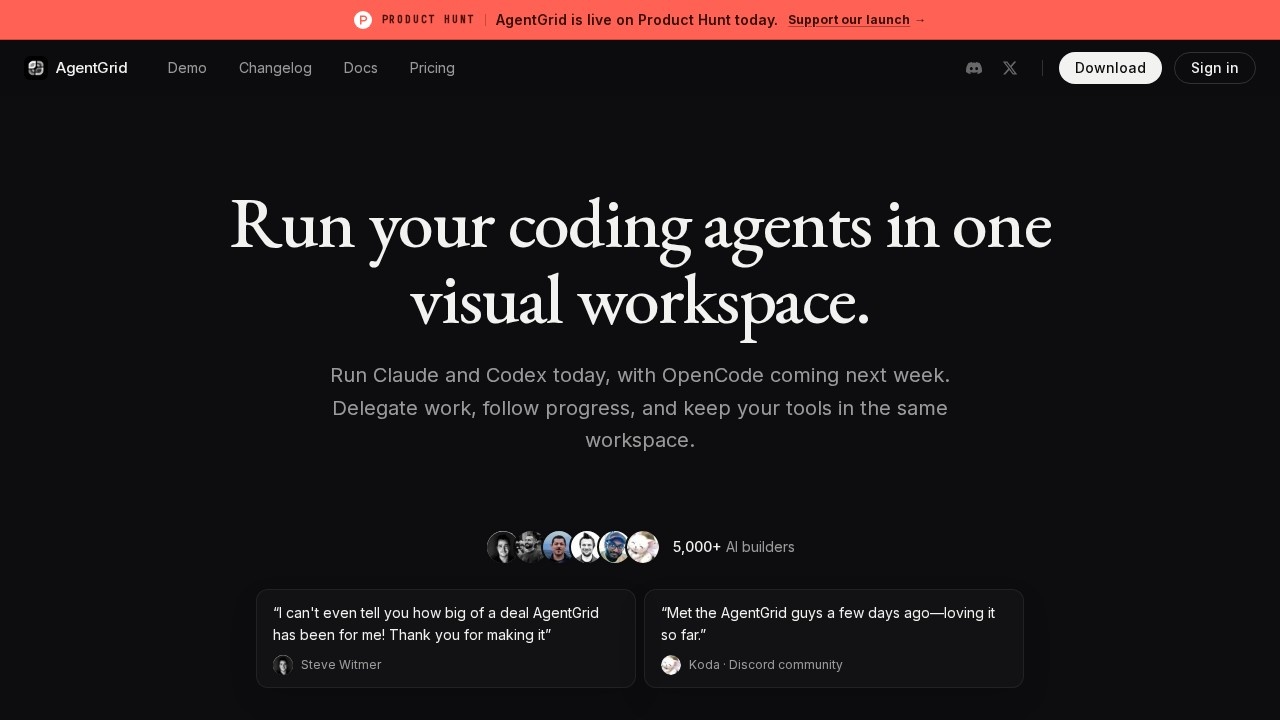
What is AgentGrid?
AgentGrid is a visual workspace that lets you run multiple AI coding agents side-by-side on an infinite canvas. It supports agents like Claude Code, Codex, and soon OpenCode, alongside terminals, browsers, and notes—all within a single project view. You can delegate tasks, track progress, and hand off work between agents without losing context. The tool is designed to streamline multi-agent workflows for developers building software.
Application scenarios
Multi-agent coding projects
Run Claude and Codex simultaneously to handle different parts of a task, like one agent building and another reviewing code.
UI/UX redesign
Spawn a builder agent to edit a landing page, then a QA agent to review the diff and approve changes.
Continuous development
Keep sessions alive across OS updates and restarts, so you can resume agents mid-task without losing progress.
Handoff between agents
When one agent hits a usage limit, open another agent in the same project, show it the visible work, and continue seamlessly.
Monitoring and debugging
Use the terminal pane to tail output and read logs while agents work, all in the same workspace.
Planning and documentation
Write notes and plans in the workspace that agents can read and act on, keeping context consistent.
Core Features
Infinite canvas workspace
Pan, zoom, arrange, and launch agents across a single visual space per project. Navigate with keyboard shortcuts like ⌘T for spaces and ⌘1–9 for agents.
Multi-agent support
Run Claude Code, Codex, and OpenCode side by side. Each agent can see the entire workspace—notes, terminal output, and other panes.
Session persistence
Save sessions to disk in `.agent-grid` files. After a restart or OS update, reopen AgentGrid and resume agents mid-task without losing work.
Usage monitoring
See each provider's current limit, reset times, and low-usage warnings in one place. Get a warning before work is interrupted.
Agent handoff
When one agent reaches a limit, open another agent in the same project, show it the visible work, and continue without copy-paste.
Integrated browser and terminal
Run a browser pane to preview localhost servers and a terminal pane to run commands like `pnpm dev`—all within the workspace.
Minimap and undo close
Navigate the canvas with a minimap and undo accidental pane closures to keep your layout intact.
Keyboard-driven workflow
Use ⌘F to search across the workspace, and ⌘T to create new spaces quickly.
Target users
AgentGrid is built for AI builders, developers, and engineering teams who work with multiple coding agents. It's especially useful for solo developers managing complex projects, small teams coordinating agent workflows, and anyone who needs to hand off tasks between Claude, Codex, or OpenCode without losing context. The tool is also relevant for QA engineers and frontend developers who want to spawn agents for building and reviewing code in parallel.
How to use AgentGrid?
- Download AgentGrid for macOS (Windows and Linux versions are also available).
- Open the app and create a new project space with ⌘T.
- Launch agents like Claude or Codex using ⌘1–9, or spawn them from the canvas.
- Use the terminal pane to run commands and the browser pane to preview localhost servers.
- Write notes and plans that agents can read and act on.
- When one agent hits a usage limit, open another agent, show it the visible work, and continue.
- Save sessions to disk in
.agent-gridfiles to resume after restarts.
Effect review
AgentGrid has attracted over 5,000 AI builders, and early feedback is strong—users describe it as "a big deal" and report loving the experience. The ability to run multiple agents in a single visual workspace, with persistence and handoff, addresses a real pain point for developers juggling Claude, Codex, and OpenCode. The integrated terminal, browser, and notes panes reduce context switching, making multi-agent workflows feel cohesive. While the tool is still in early access and OpenCode support is coming next week, the current feature set already delivers a practical, well-designed solution for managing coding agents at scale.
Frequently Asked Questions
What is AgentGrid?
Which AI agents does AgentGrid support?
Can I use terminals and browsers within AgentGrid?
Is AgentGrid free to use?
What makes AgentGrid different from other AI tools?
AgentGrid - AI Tool Detail
AgentGrid by AgentGrid provides a unified infinite canvas for managing multiple AI agents, including Claude Code, Codex, and OpenCode, alongside terminals, browsers, and notes for streamlined multi-ag
Category:Multi-agent collaboration
Visit Link:https://agentgrid.sh/
Tags:AI agents、multi-agent management、infinite canvas、workflow automation、agent orchestration