
Mnemosyne
Mnemosyne by its developers is a native, sub-millisecond memory system for AI agents, built on SQLite. It offers 500x faster performance than cloud alternatives with no HTTP, servers, or API keys, mak
What is Mnemosyne?
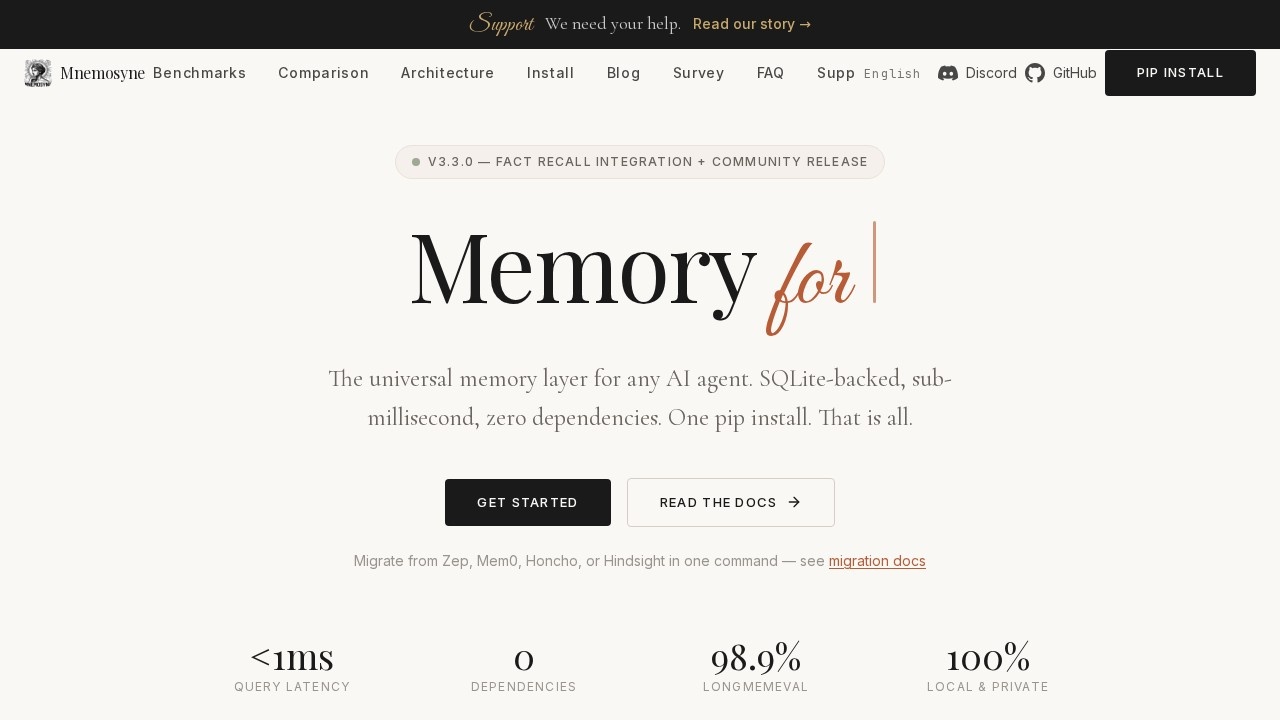
Mnemosyne is a native, sub-millisecond memory system for AI agents, built entirely on SQLite. It provides a universal memory layer that any AI agent can use for fast, persistent recall—without cloud services, HTTP servers, or API keys. Developers install it with a single pip command and get instant, local memory that works offline and stays 100% private. It's designed to replace cloud-based memory providers like Zep, Mem0, or Honcho with a simpler, faster, and fully local alternative.Application scenarios
AI agent memory persistence
Give any AI agent (like Claude Code, Cursor, or Hermes) long-term memory that survives sessions and conversations.
Personal assistant development
Build local assistants that remember user preferences, past interactions, and context without sending data to the cloud.
Offline AI applications
Run memory-dependent AI workflows on devices with no internet connection—even in airplane mode.
High-frequency query systems
Use sub-millisecond memory retrieval for real-time applications where latency matters, like live chat or interactive agents.
Research and benchmarking
Test memory retrieval at scale with the BEAM benchmark (ICLR 2026) for 100K to 1M token contexts.
Migration from existing memory tools
Switch from Zep, Mem0, Honcho, or Hindsight in one command using the provided migration docs.
Core Features
Sub-millisecond latency
Direct SQLite access delivers queries under 1ms with no network overhead or HTTP roundtrips.
100% private and local
All data stays on your machine—no cloud services, no data ever leaves your device.
Native vector search
Built-in sqlite-vec integration for semantic search with hybrid ranking (50% vector + 30% FTS + 20% importance).
Beam architecture
Three-tier memory system—working_memory for hot context, episodic_memory for long-term storage, and scratchpad for reasoning.
Auto consolidation
Old working memories are automatically summarized and moved to episodic storage via configurable sleep cycles.
Hybrid search
Combines vector similarity, full-text search, and importance scoring for optimal recall accuracy.
Streaming and DeltaSync
Real-time incremental memory updates with streaming results as they arrive—no waiting for full batches.
Smart filtering
Use ignore_patterns to block noisy or irrelevant content from entering memory, keeping context windows clean.
Target users
AI developers and engineers building autonomous agents, chatbots, or local AI applications. This includes teams working with Hermes, Claude Code, Cursor, Codex, OpenWebUI, or OpenClaw who need fast, persistent memory without cloud dependencies. Also suitable for researchers running memory retrieval benchmarks or anyone migrating from cloud memory providers to a local solution.How to use Mnemosyne?
Install it withpip install mnemosyne-memory. No configuration files, environment variables, or cloud accounts are needed. Import the remember and recall functions directly in your code—store memories with remember("content", importance=0.9, scope="global") and retrieve relevant context with recall("query"). For existing users of Zep, Mem0, Honcho, or Hindsight, use the provided migration command to switch instantly. Full documentation is available at the official site.Pricing and free trial
Mnemosyne is free forever. The comparison table on the site lists its cost as "Free forever" versus paid plans for Honcho, Zep, and Mem0.Effect review
Mnemosyne delivers exactly what it promises: a zero-dependency, sub-millisecond memory system that runs entirely on your machine. The performance numbers are striking—0.81ms write, 0.076ms read, and instant cold start—all measured on CPU without GPU. For developers tired of managing API keys, cloud credits, and network latency, this is a refreshingly simple alternative. The BEAM benchmark results at 100K, 500K, and 1M token contexts show it handles scale, though real-world performance will depend on your specific workload. If you need fast, private, offline memory for AI agents and don't want to pay per query, Mnemosyne is a strong contender worth trying.Frequently Asked Questions
What is Mnemosyne?
How does Mnemosyne achieve such high speed?
Do I need an internet connection to use Mnemosyne?
What are the system requirements for running Mnemosyne?
Can Mnemosyne integrate with existing AI agent frameworks?
Is Mnemosyne open-source?
Mnemosyne - AI Tool Detail
Mnemosyne by its developers is a native, sub-millisecond memory system for AI agents, built on SQLite. It offers 500x faster performance than cloud alternatives with no HTTP, servers, or API keys, mak
Category:Agents
Visit Link:https://mnemosyne.site/
Tags:offline memory、SQLite AI、fast retrieval、agent memory