
oprel
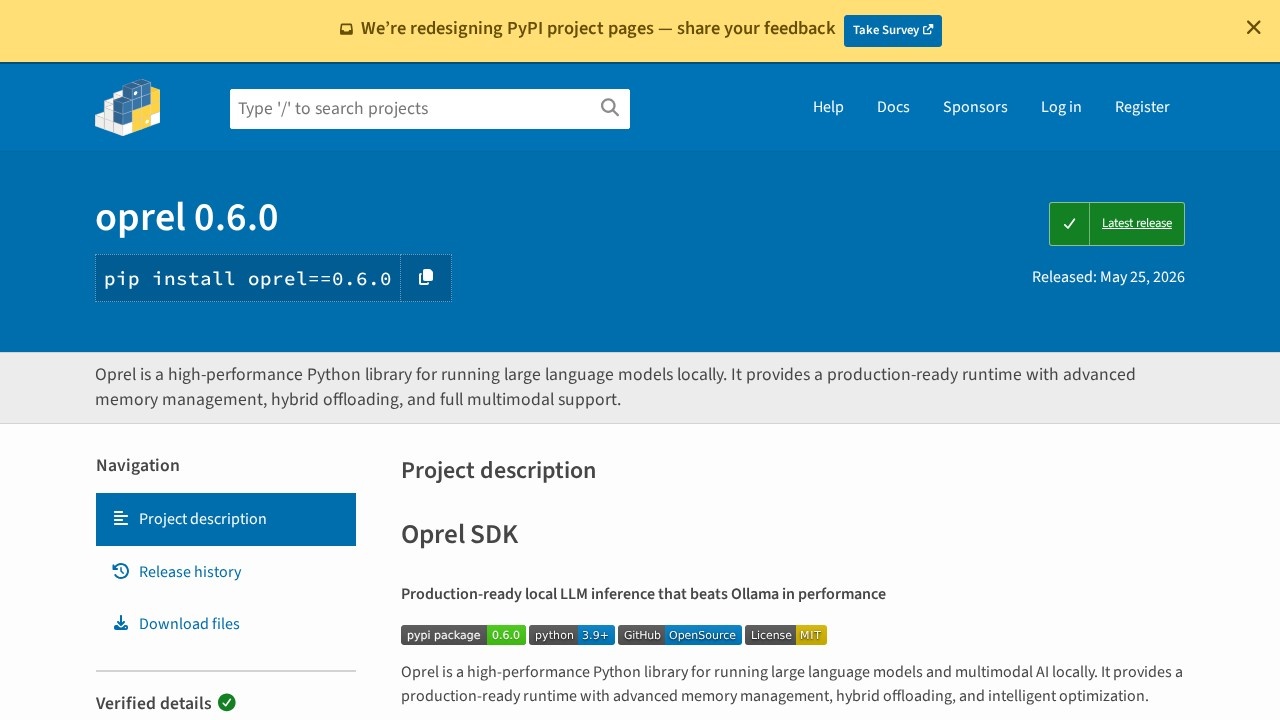
High-performance Python library by Oprel for running large language models locally, featuring production-ready runtime, advanced memory management, hybrid offloading, and full multimodal support.
What is oprel?
Oprel is a high-performance Python library for running large language models (LLMs) and multimodal AI locally. It provides a production-ready runtime with advanced memory management, hybrid offloading, and intelligent optimization. Users leverage it for text generation, vision tasks, and image/video generation directly on their own hardware, without relying on cloud services. It claims to beat Ollama in performance, offering a drop-in replacement for the Ollama API.Application scenarios
Local LLM inference
Run large language models like Llama, Mistral, or DeepSeek on your own machine for text generation and chatbot applications.
Multimodal AI tasks
Use vision models (via llama.cpp) for image understanding and generation, plus diffusion models (via ComfyUI integration) for image and video creation.
Offline AI development
Build and test conversational AI, text generation, or AI-powered tools without an internet connection.
Privacy-sensitive applications
Keep data on-premise for use cases in healthcare, finance, or legal where data cannot leave the local environment.
Edge and embedded AI
Deploy models on resource-constrained devices (e.g., low-VRAM GPUs) using hybrid offloading and CPU acceleration.
Production model serving
Use server mode with zero-latency caching for real-time inference in applications or APIs.
Core Features
Multi-Backend Architecture
Supports llama.cpp for text generation and vision (GGUF models) and ComfyUI for image and video generation with diffusion models.
Hybrid GPU/CPU Offloading
Runs 13B-parameter models on GPUs with as little as 4GB VRAM by intelligently splitting layers between GPU and CPU.
Auto-Quantization
Automatically selects the best quality quantization level based on your available VRAM, balancing performance and accuracy.
CPU Acceleration
Uses AVX2/AVX512 optimizations, delivering 30-50% faster inference than Ollama's default settings.
KV-Cache Aware Memory Planning
Prevents out-of-memory (OOM) crashes by precisely planning memory usage based on the KV cache.
Memory Pressure Monitor
Proactively warns users before memory-related crashes occur, allowing time to adjust settings.
Idle Cleanup
Automatically frees GPU and CPU resources after 15 minutes of inactivity, reducing resource waste.
Zero-Latency Server Mode
Keeps models cached in memory for instant response times when serving requests.
Oprel Studio
A premium web UI for chat, model management, real-time hardware monitoring, and integrated RAG (Retrieval-Augmented Generation).
Ollama API Compatibility
Acts as a drop-in replacement for the Ollama API, making migration straightforward.
Target users
- Developers building local AI applications, chatbots, or text-generation tools in Python.
- Data scientists and researchers who need to run LLMs or multimodal models on their own hardware for experimentation.
- IT and DevOps teams deploying on-premise or edge AI solutions for privacy or latency requirements.
- AI enthusiasts who want to run models locally without relying on cloud services or subscription fees.
How to use oprel?
Install the library via pip:pip install oprel. For server mode, use pip install oprel[server]. After installation, you can load models using the Oprel runtime, configure hybrid offloading or auto-quantization, and run inference. For a full web interface, use Oprel Studio. Detailed documentation and examples are available on the project's official homepage and documentation links.Effect review
Oprel positions itself as a high-performance alternative to Ollama, with clear technical advantages in memory management and CPU acceleration. The hybrid offloading feature is particularly valuable for users with limited GPU VRAM, enabling larger models to run on modest hardware. The inclusion of auto-quantization and proactive memory monitoring suggests a focus on reliability and ease of use, reducing the guesswork in model deployment. While the library is still in Beta (Development Status 4), the feature set—especially the ComfyUI integration for diffusion models—makes it a compelling choice for developers needing a unified local AI runtime. Without independent benchmarks or user testimonials, the performance claims remain unverified, but the technical specifications are promising for local inference tasks.Frequently Asked Questions
What is oprel?
Can oprel handle multimodal models?
Is oprel free to use?
Does oprel support GPU acceleration?
How does oprel manage memory efficiently?
oprel - AI Tool Detail
High-performance Python library by Oprel for running large language models locally, featuring production-ready runtime, advanced memory management, hybrid offloading, and full multimodal support.
Category:Training Deployment Tool
Visit Link:https://pypi.org/project/oprel/0.6.0/
Tags:LLM、Python library、local inference、multimodal、memory management