
Shoehorn
Developer platform by Shoehorn for service catalog, documentation, and templates that adapts to your existing stack.
What is Shoehorn?
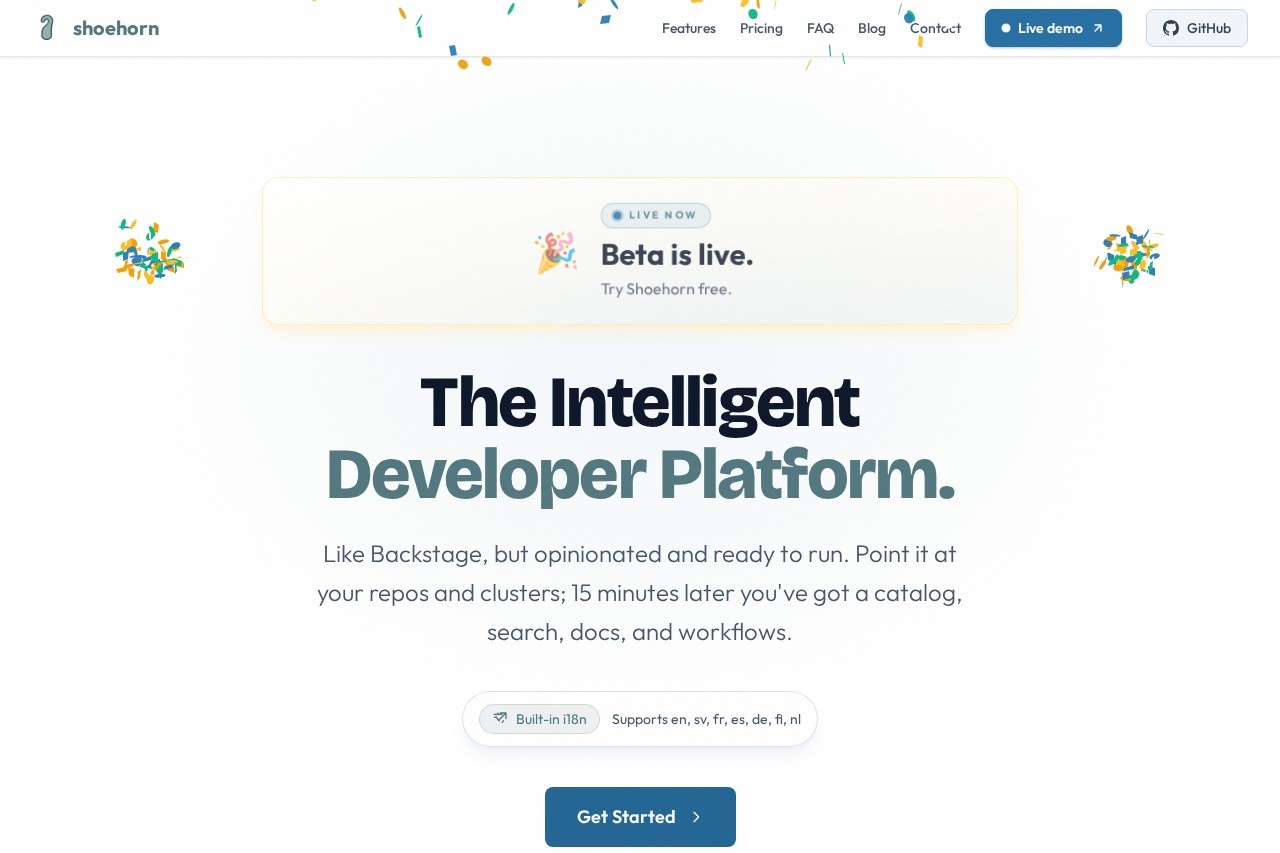
Shoehorn is an intelligent developer platform that acts like an opinionated, ready-to-run version of Backstage. It automatically crawls your GitHub repos and Kubernetes clusters to build a service catalog, search, documentation, and workflows in about 15 minutes. Users point it at their existing stack, and it runs as just another service in their infrastructure—no dedicated portal team needed to keep it alive. It’s Backstage-compatible, meaning your existingcatalog-info.yaml files work without modification.Application scenarios
Incident response
At 2am when a service goes down, instantly find who owns it and who to page without asking in Slack.
Impact analysis
Before deprecating an API endpoint, see exactly how many services depend on it and the blast radius of changes.
Service onboarding
Use reusable Forge molds to scaffold new repos with consistent CI configs, eliminating copy-paste errors.
Multi-language teams
Built-in i18n supports English, Swedish, French, Spanish, German, Finnish, and Dutch for global teams.
Governance enforcement
Approval workflows ensure the right people sign off before changes or new services go live.
Infrastructure automation
Manage Shoehorn config via Terraform, CLI, or REST API to keep everything version-controlled and repeatable.
Core Features
Auto-discovered service catalog
Shoehorn crawls your repos and clusters to map what’s running, who owns it, dependencies, and where docs live—no manual entry required.
Instant search
Find services, APIs, and owners in under 200ms across your entire stack.
Dependency graph with impact analysis
View blast radius at configurable depth (1–5 levels) before making changes.
Forge molds
Reusable workflows to scaffold repos and provision infrastructure consistently.
Approval workflows
Built-in sign-off gates ensure changes meet governance requirements.
Kubernetes agent
Drop in a k8s-agent that pushes workload data to Shoehorn with no inbound access required.
Terraform Provider
Manage Shoehorn configuration in Git the same way you manage everything else.
CLI and REST API
Automate from the terminal or CI pipelines—every UI action is also an HTTP call.
Admin UI
Point-and-click interface for the parts you’d rather not script.
Backstage compatibility
Existing `catalog-info.yaml` files work out of the box.
Target users
Platform engineers, DevOps teams, and SREs who want a self-hosted developer portal without a dedicated platform team to maintain it. Also suits engineering managers and on-call engineers who need instant visibility into service ownership, dependencies, and documentation across their entire stack.How to use Shoehorn?
- Connect your stack: Point Shoehorn at your GitHub org, clusters, and repos. Setup takes about 15 minutes.
- Let it map: Shoehorn crawls repos directly. For clusters, drop in the k8s-agent to push workloads without inbound access.
- Start searching: Use the UI, CLI, REST API, or Terraform to search across everything, view dependencies, and run approval workflows.
The self-hosted beta launches 8th May 2026 at 21:00 CEST. Visit shoehorn.dev to sign up.
Effect review
Shoehorn delivers exactly what it promises: a developer platform that works with your existing stack in minutes, not weeks. The auto-discovery of services, dependencies, and ownership eliminates the common "ask around in Slack" bottleneck during incidents. Its Backstage compatibility means teams with existing catalog files can migrate without rework. The multi-interface approach—Terraform, CLI, REST API, and UI—gives teams flexibility without forcing a specific workflow. While the product is still in beta and launching in May 2026, the feature set already addresses the three most common platform pain points: ownership discovery, change impact analysis, and consistent scaffolding. For teams tired of maintaining a separate portal team, Shoehorn’s "just another service in your stack" philosophy is a practical, low-overhead alternative.Frequently Asked Questions
What is Shoehorn?
How does Shoehorn adapt to my existing stack?
Can I use Shoehorn for documentation?
Does Shoehorn offer templates?
Is Shoehorn suitable for my team size?
Shoehorn - AI Tool Detail
Developer platform by Shoehorn for service catalog, documentation, and templates that adapts to your existing stack.
Category:Aggregation platform
Visit Link:https://shoehorn.dev/
Tags:developer platform、service catalog、documentation、templates、stack integration