
Product Patterns
Product Patterns by Riyaj offers real UX patterns from digital products, showcasing behavioral psychology, design frameworks, and psychological principles applied in modern experiences for designers a
What is Product Patterns?
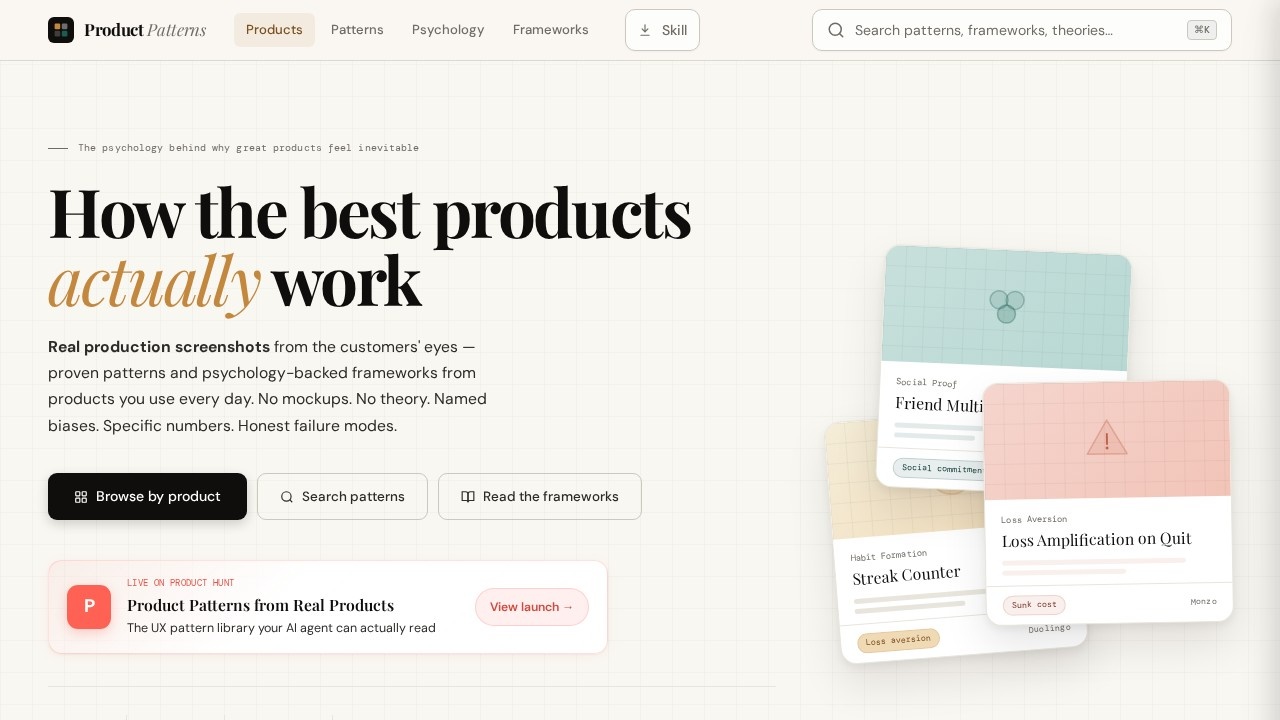
Product Patterns is a curated library of real UX patterns sourced from digital products you use every day. It documents behavioral psychology, design frameworks, and psychological principles applied in modern experiences—directly from production screenshots, not mockups. Users can browse patterns by product, search by keywords, or explore frameworks and theories. The goal is to show how great products actually work, with named biases, specific numbers, and honest failure modes.
Application scenarios
UX research
Study real-world patterns from 72+ products to understand what makes interfaces feel inevitable.
Design inspiration
Browse production screenshots from companies like Duolingo, Monzo, and Apple to see proven interaction patterns.
Behavioral psychology application
Learn how concepts like loss aversion, social proof, and habit formation are implemented in live products.
Product strategy
Analyze frameworks and psychological theories behind successful features to inform your own product decisions.
Design system education
Use the pattern library as a teaching tool for teams or students learning about UX best practices.
Competitive analysis
Filter patterns by specific products (e.g., Google, OpenAI, Figma) to compare design approaches.
Core Features
Pattern library by product
Browse 303 patterns organized across 72 products, each sourced from real production screenshots. Click any product card to filter the library.
Psychology-backed frameworks
Access 9 frameworks that explain how psychological biases and principles are applied in product design.
Theory exploration
Dive into 32 psychological theories (e.g., Habit Formation, Loss Aversion, Social Proof) with real-world examples.
Search and filter
Use the search bar (⌘K) to find patterns, frameworks, or theories by name or keyword.
Product-specific filtering
Each product card shows the number of patterns available (e.g., Littlebird has 28 patterns, Google has 22, Granola has 18).
Named biases with specifics
Each pattern includes named biases, specific numbers, and honest failure modes—no vague theory.
Real screenshots from customer perspective
All visuals are actual production screenshots taken from the user's point of view, not mockups or wireframes.
Target users
This tool is built for UX designers, product managers, behavioral design specialists, and anyone who wants to understand why great products feel inevitable. It's also useful for design educators, startup founders, and AI agents that need a structured pattern library to inform design decisions.
How to use Product Patterns?
Open the site at https://patterns.riyaj.in/. Use the search bar (⌘K) to find specific patterns, frameworks, or theories. Browse the product cards to filter patterns by company—click any product to see its associated patterns. Alternatively, explore the "Patterns," "Psychology," or "Frameworks" sections directly from the navigation. No account or sign-up is required based on the website text.
Effect review
Product Patterns delivers exactly what it promises: a no-fluff library of real UX patterns backed by psychology and real production screenshots. The sheer volume—303 patterns across 72 products—makes it a practical reference for designers who want to move beyond theory. The inclusion of named biases, specific numbers, and failure modes adds credibility that typical pattern libraries lack. While the site doesn't include user testimonials or awards, the curation quality is evident from the breadth of products covered (from Duolingo to Monzo to OpenAI). For anyone building digital products, this is a resource that turns abstract psychology into actionable design insights.
Frequently Asked Questions
What is Product Patterns?
Who created Product Patterns?
What kind of content does Product Patterns offer?
Is Product Patterns free to use?
Who is Product Patterns for?
How can Product Patterns help me as a designer?
Product Patterns - AI Tool Detail
Product Patterns by Riyaj offers real UX patterns from digital products, showcasing behavioral psychology, design frameworks, and psychological principles applied in modern experiences for designers a
Category:UI design
Visit Link:https://patterns.riyaj.in/
Tags:UX patterns、behavioral psychology、design frameworks、psychological principles、digital product design