
Motiff
Motiff is an AI-powered UI design tool that acts as your design partner, helping individuals and teams create more efficiently and unleash their creativity.
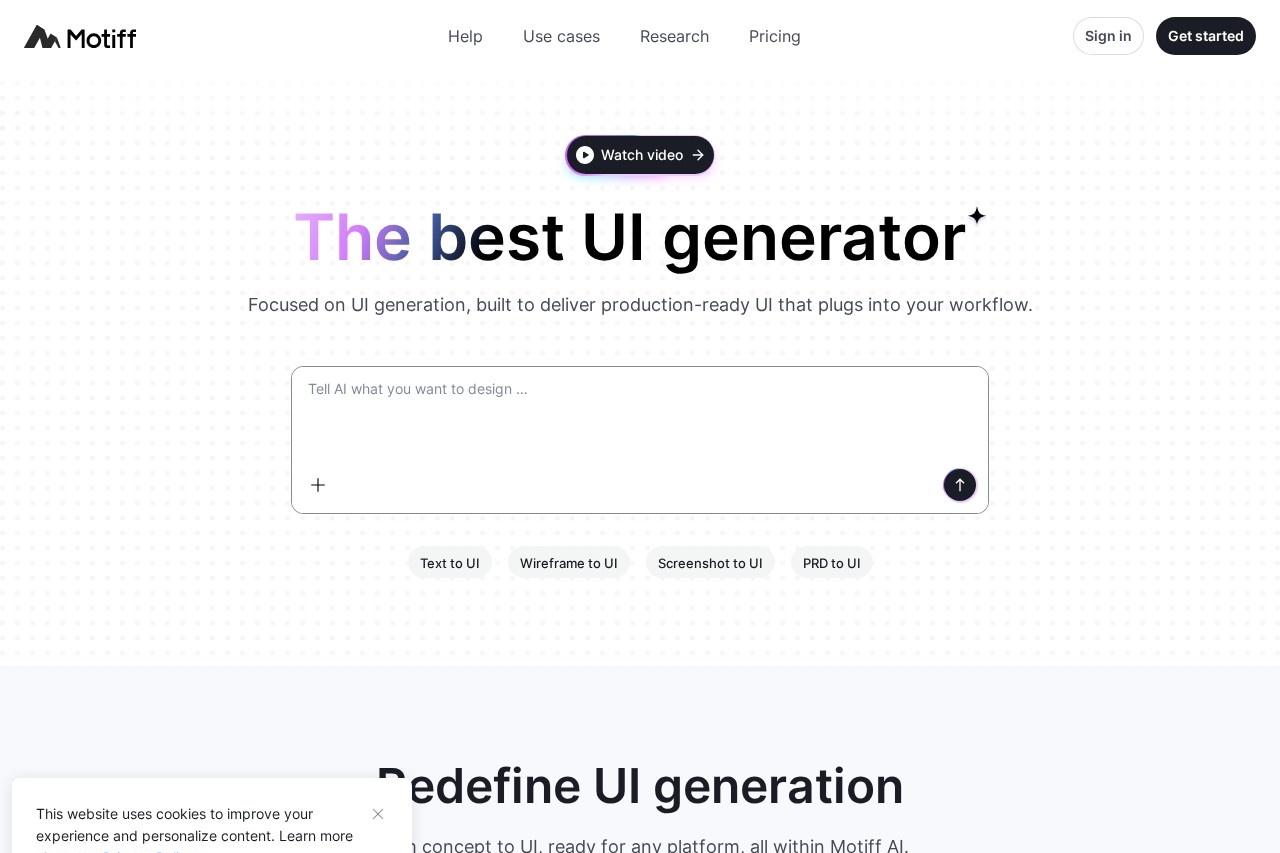
What is Motiff?
Motiff is an AI-powered user interface design tool. It functions as a design partner for individuals and teams, aiming to enhance efficiency and creativity in the product design workflow. The tool provides a comprehensive professional interface editor, design system, and prototyping tools for real-time cloud collaboration. It is positioned as a direct alternative to tools like Figma, Sketch, and Adobe XD.Application scenarios
UI/UX Design
Creating and iterating on user interface designs for digital products.
Design System Management
Building and maintaining design systems with components and styles.
Prototyping
Developing interactive prototypes to demonstrate user flows.
Design Team Collaboration
Enabling real-time, cloud-based collaborative design work for teams.
Design-to-Development Handoff
Generating production-ready front-end code from design files for engineers.
Rapid Ideation & Mockups
Quickly generating design concepts and initial drafts from text or image prompts.
Core Features
AI Style Learning
Import typical product interfaces to teach the AI your existing design style, making it a team assistant.
Style-Matched Generation
AI generates new interfaces or redesigns existing ones that match your learned design style.
AI-Assisted Complex Design
Collaborate with AI to rapidly present creative ideas or provide multiple creative options for complex designs.
Targeted Iteration
Select a specific area of an existing design for the AI to modify, generating multiple new versions based on your direction.
Context-Aware Module Generation
AI generates appropriate UI modules like cards, buttons, or component variants based on the surrounding design context.
Text or Image to Design
Generate designs by describing your intent in text or by providing an image sketch for the AI to interpret.
Integrated Image Editing & Text Tools
Edit images, rewrite copy, or translate text within the tool without needing other software.
AI-Powered Code Generation (MCP)
The tool understands interface designs and generates highly accurate front-end code in multiple formats, ready for engineers to use.
High-Performance Editor
Built with a focus on performance and user experience, claiming superior performance to Figma in some key scenarios.
Seamless Figma Migration
Migrate design files from Figma with complete layer positioning, variables, components, and styles preserved.
Target users
Motiff serves independent designers, small to large teams, and entire enterprises. Key beneficiaries include UI/UX designers, product design teams, front-end developers who use generated code, and large organizations with multiple business lines that require batch migration services and scalable seat management.How to use Motiff?
The process begins by registering for an account on the Motiff website. Users can then import existing design files or start a new project in the cloud-based editor. To leverage AI, you can import interfaces to train it on your style, use text or image prompts to generate designs, or select specific areas on a canvas for AI-powered iteration. Teams can collaborate in real-time on projects. For handoff, the tool can generate code for developers. The site offers help documentation and quick-start guides for onboarding.Pricing and free trial
Motiff offers a free registration tier and several paid plans with different seat types:- Professional版: For independent designers and small teams.
* AI Design Seat: ¥90/month (includes 1000 credits/month)
* Design Seat: ¥24/month
* Development Seat: ¥6/month
- Enterprise版 (Most Popular): For medium and large enterprises.
* AI Design Seat: ¥200/month (includes 2000 credits/month)
* Design Seat: ¥90/month
* Development Seat: ¥18/month
- Group版: For large enterprises with multiple business lines.
* AI Design Seat: ¥300/month (includes 3000 credits/month)
* Design Seat: ¥150/month
* Development Seat: ¥30/month
Effect review
Motiff presents a feature set that directly targets core pain points in modern UI design workflows. The deep integration of AI for style learning, contextual generation, and targeted iteration promises a significant shift from a purely manual process to a collaborative partnership, potentially freeing designers from repetitive tasks. The claim of outperforming Figma in specific performance scenarios, coupled with a reliable migration path, makes it a compelling option for teams seeking efficiency gains. By bridging the gap between design and development with its AI-generated code, Motiff aims to streamline the entire product delivery cycle, not just the design phase. The tiered pricing model clearly scales from individual practitioners to large corporations.Frequently Asked Questions
What is Motiff?
How does Motiff use AI to assist with design?
Who can benefit from using Motiff?
Can Motiff help with collaborative design projects?
What types of design projects is Motiff suitable for?
Is Motiff easy to learn for beginners?
Motiff - AI Tool Detail
Motiff is an AI-powered UI design tool that acts as your design partner, helping individuals and teams create more efficiently and unleash their creativity.
Category:UI design
Visit Link:https://motiff.com/
Tags:UI design、AI design assistant、creative tool、design collaboration、prototyping