
Deep Work Plan
Deep Work Plan is a tool by its developers that transforms any repository into a structured environment, enabling coding agents to complete long-horizon tasks efficiently with context-driven focus.
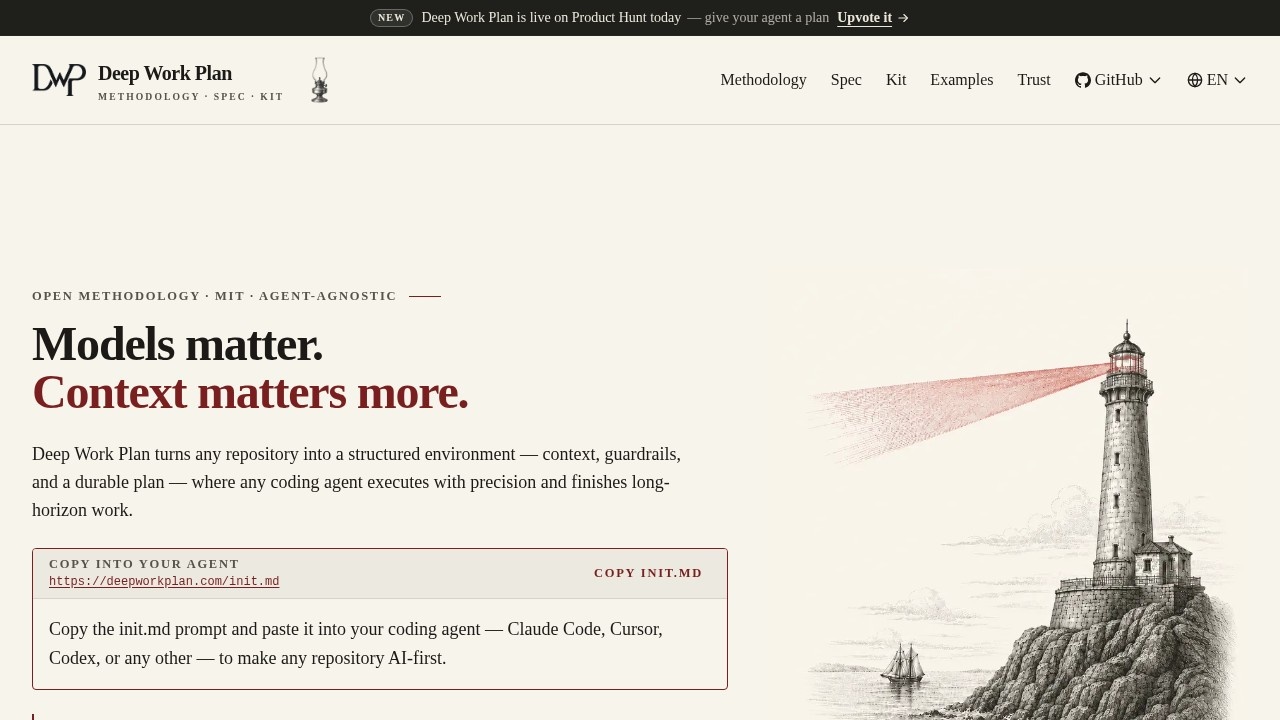
What is Deep Work Plan?
Deep Work Plan is an open-source, MIT-licensed tool that transforms any repository into a structured environment for coding agents. It enables agents to execute long-horizon tasks—like migrations, refactors, or new subsystems—with precision by providing context, guardrails, and a durable plan. The tool is agent-agnostic, meaning it works with Claude Code, Cursor, Codex, or any other coding agent. It installs a portable harness directly into the repository itself, making the repo AI-first and verifiable across sessions.
Application scenarios
Large-scale code migrations
Agents can execute multi-file migrations without losing context or abandoning the task halfway.
New subsystem development
The structured plan and acceptance criteria keep agents focused on building a complete subsystem from scratch.
Cross-file refactoring
Refactors across dozens of files stay on track because the plan is the durable source of truth.
Multi-session development
Any agent can resume work across sessions, as the plan and state persist in the repository.
Repository onboarding for AI
New or existing repos become AI-first with a single init prompt, enabling agents to navigate and execute immediately.
Team collaboration
Multiple agents or developers can work on the same repo using the same harness and documentation.
CI/CD integration
The tool inspects your validation commands and generates artifacts that align with your existing test, lint, and build pipelines.
Core Features
Reasoning-based onboarding
The tool inspects your repository's actual languages, frameworks, package manager, and validation commands—then generates artifacts adapted to that repo, not generic stubs.
Automated AGENTS.md generation
It creates a reasoned AGENTS.md file, a categorized docs/ hierarchy, and per-module READMEs filled with your real commands, not placeholders.
Cross-agent .agents/ scaffolding
Sets up a .agents/ directory with skills, agents, and commands, plus a .claude to .agents symlink so every tool reads one source of truth.
DWP skill installation
Wires the Deep Work Plan skill and creates a gitignored .dwp/ folder for plans and drafts, with opt-in addons like devcontainer support.
Spec-driven development
The plan acts as the durable source of truth, with explicit acceptance criteria and validation gates that keep agents on track.
Agent-agnostic compatibility
Works with Claude Code, Cursor, Codex, or any other coding agent—no vendor lock-in.
Portable harness engineering
The harness (context, tools, control loop, guardrails, resumable state) is installed into the repository itself, so any agent can pilot any repo.
One-instruction setup
You simply copy the init.md prompt into your agent—no install methods or template copying required.
Target users
Deep Work Plan is built for developers and teams who use AI coding agents for complex, long-horizon software tasks. It suits individual developers working on large refactors or migrations, as well as engineering teams who need consistent, verifiable execution across multiple agents and sessions. It's also valuable for platform engineers who want to make their repositories AI-first without manual configuration.
How to use Deep Work Plan?
- Copy the init.md prompt from https://deepworkplan.com/init.md.
- Paste it into your coding agent—Claude Code, Cursor, Codex, or any other.
- Point the agent at any repository. The onboarding flow reasons about your stack, generates AGENTS.md and docs, scaffolds .agents/, and installs the DWP skill.
- The agent executes against the plan, with explicit acceptance criteria and validation gates. Work can be resumed across sessions.
Effect review
Deep Work Plan directly addresses a real pain point: AI agents losing context and abandoning long tasks. The reasoning-based onboarding is a standout feature—it adapts to your actual repository instead of forcing generic templates. The agent-agnostic design and MIT license make it practical for any team, and the spec-driven approach ensures work stays verifiable. While the tool is battle-tested at Dailybot, there's no mention of user feedback or awards in the provided text. For developers already using coding agents, Deep Work Plan offers a structured, portable harness that should reduce drift and increase task completion rates.
Frequently Asked Questions
What is Deep Work Plan?
How does Deep Work Plan help coding agents?
Can Deep Work Plan be used with any repository?
Is Deep Work Plan free to use?
What types of tasks can Deep Work Plan handle?
Deep Work Plan - AI Tool Detail
Deep Work Plan is a tool by its developers that transforms any repository into a structured environment, enabling coding agents to complete long-horizon tasks efficiently with context-driven focus.
Category:Agents
Visit Link:https://deepworkplan.com/
Tags:coding agents、repository management、long-horizon tasks、context-driven focus、development efficiency