VulX
VulX by VulX Security offers end-to-end security reviews for AI-built apps, covering keys, dependencies, storage rules, and injection flaws. It focuses on proving whether outsiders can truly reach you
What is VulX?
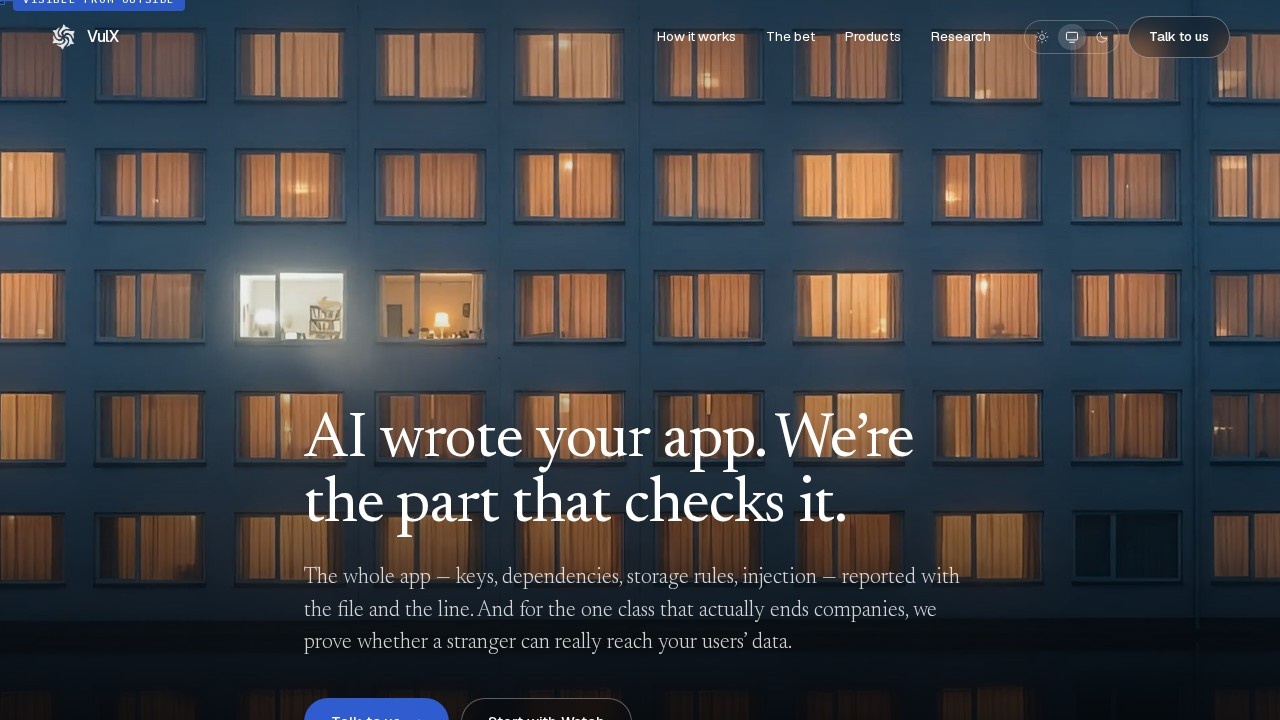
VulX is a security review service built specifically for applications that AI wrote. It performs end-to-end checks across the entire app—keys, dependencies, storage rules, and injection flaws—and reports findings with the exact file and line number. The core focus is on the most dangerous failure class: broken access control, where a stranger can reach another user's data by changing an ID in a URL. VulX doesn't just warn you that something might be open; it actively proves whether an anonymous role can actually read data it should never see. The service runs hands-on under contract, not as a self-serve button.
Application scenarios
AI-generated app review
Teams using tools like Tea, Lovable, or Moltbook can get a full security audit of the code AI produced.
Access-control verification
VulX identifies routes that hand over any record to anyone who alters the ID in the URL—the failure class that "ends companies."
Data-exposure testing
It narrows the app to the few places private data is reachable, using the app's own data-access and row-level-security rules.
Patch validation
After a fix is written, VulX checks that the exact same attack now fails while a legitimate user can still read their own data.
Pre-merge security gate
A patch becomes a pull request only if the attack fails, the real user works, tests pass, and the project still builds.
Core Features
Whole-app scanning
VulX reads the entire application—keys, dependencies, storage rules, and injection points—and reports what it can verify, with the file and line.
Access-rule inference
It infers the access rule the code was supposed to enforce, separating genuinely reachable vulnerabilities from merely suspicious ones.
Proof-of-exploit testing
VulX plants a canary and runs an anonymous role that reads a row it should never see, inside a single transaction that is always rolled back—nothing of yours is read.
Hands-on engagement
The testing runs under contract, not as an automated button you press.
Safe patch generation
VulX produces a fix that closes the hole without locking out legitimate users—the second check almost nobody runs.
Four-part merge gate
A patch becomes a pull request only if the same attack fails, the real user still works, tests pass, and the project still builds.
Review-ready branches
What arrives is a branch to review; you merge it, VulX doesn't.
Roadmap for autonomy
Full autonomy is planned, earned with a track record rather than assumed.
Target users
VulX is built for engineering teams shipping AI-generated applications—especially those using no-code or low-code builders like Tea, Lovable, or Moltbook. It's also relevant for security-conscious startups and product teams that want a verified answer to the question: "Can a stranger actually reach our users' data?" The service suits teams that need more than static tooling—they need proof, a working patch, and a merge-ready branch.
How to use VulX?
The website doesn't describe a self-serve signup flow. VulX engagements are scoped per app and run hands-on under contract. To get started, you talk to the VulX team directly—the site offers a "Talk to us" entry point. Enterprise engagements are scoped per app, and self-serve monitoring is listed as free while the team builds it out. For practical next steps, visit the official site at https://vulx.ai/.
Effect review
VulX targets a specific, high-impact problem: broken access control in AI-written apps. The approach is refreshingly concrete—instead of generic warnings, it proves exploitability with a rolled-back transaction and a canary, then delivers a patch that passes a strict four-part gate. The emphasis on not breaking legitimate users during the fix is a practical differentiator, as that's where most security patches fail. The service is hands-on and contract-based, which means it's not a plug-and-play tool for every team, but for those shipping AI-generated code at scale, it offers a level of verification that static scanners can't match. The roadmap toward full autonomy suggests the team is thinking about scale, but for now, the value is in the depth of the manual engagement.
Frequently Asked Questions
What types of security issues does VulX check for in AI-built apps?
How does VulX prove whether outsiders can reach my app?
Is VulX suitable for non-technical users?
Does VulX require integration with my existing development workflow?
Can VulX detect zero-day vulnerabilities?
How often should I run security reviews with VulX?
VulX - AI Tool Detail
VulX by VulX Security offers end-to-end security reviews for AI-built apps, covering keys, dependencies, storage rules, and injection flaws. It focuses on proving whether outsiders can truly reach you
Category:Programming Assistant
Visit Link:https://vulx.ai/
Tags:AI security scanner、vulnerability assessment、AI app security、penetration testing、secure coding review