
MiniMax M3
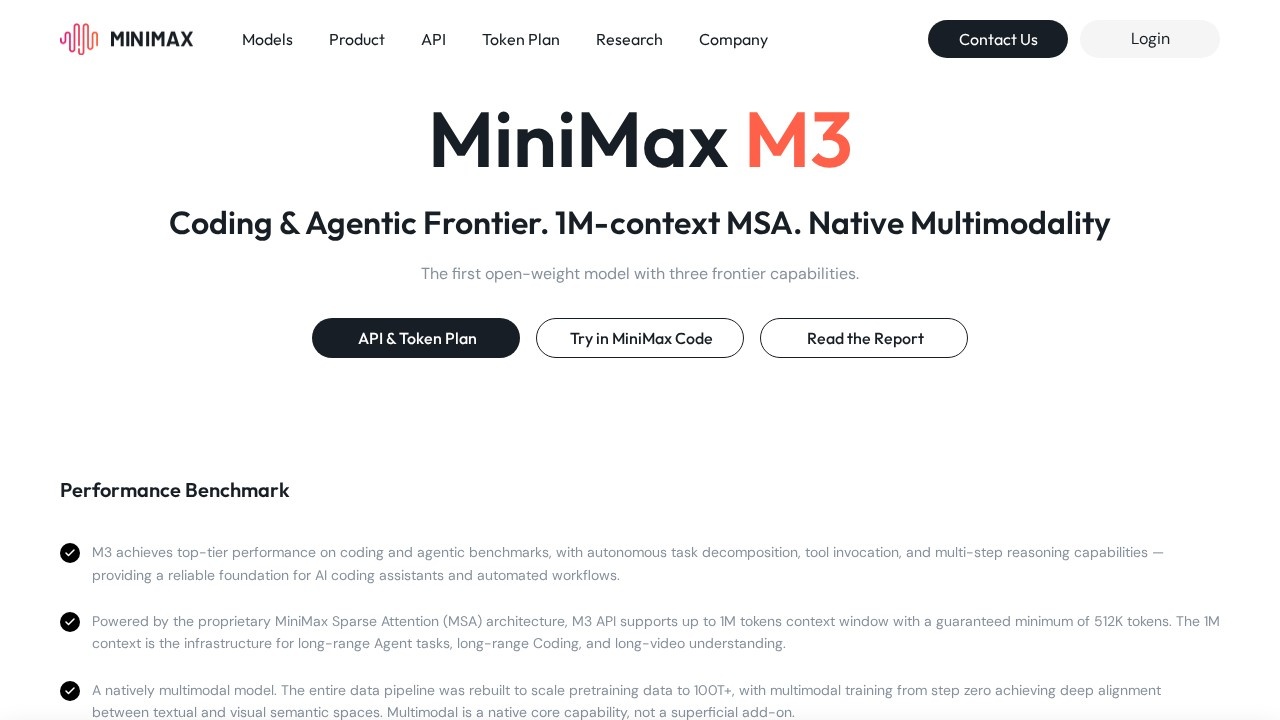
MiniMax M3 is an open-weight model by MiniMax for coding, agentic tasks, and multimodal understanding, with a 1M context window powered by MSA architecture.
What is MiniMax M3?
MiniMax M3 is an open-weight model that combines coding, agentic tasks, and multimodal understanding in a single system. It is built on the proprietary MiniMax Sparse Attention (MSA) architecture, which supports up to a 1M token context window with a guaranteed minimum of 512K tokens. Users can leverage M3 for autonomous task decomposition, tool invocation, and multi-step reasoning, making it a reliable foundation for AI coding assistants and automated workflows. It is the first open-weight model to deliver frontier capabilities in coding, million-token context, and native multimodality.Application scenarios
Autonomous code development
M3 can independently reproduce research papers, running for nearly 12 hours to generate commits and experimental figures.
CUDA kernel optimization
It can optimize compute-intensive operations like FP8 GEMM on NVIDIA Hopper GPUs, achieving significant speedups with zero human intervention.
Long-range agent tasks
The 1M context window enables handling of extended sequences for agentic workflows and long-video understanding.
Automated data pipeline
M3 can autonomously complete the full pipeline of data synthesis, training, evaluation, and iteration for pretrain-only base models.
Multimodal analysis
It parses charts and formulas from papers, integrating textual and visual information for deep understanding.
Long-range coding
The extended context supports complex coding tasks that require maintaining large codebases or logs in a single window.
Core Features
1M-context MSA architecture
The MiniMax Sparse Attention (MSA) architecture supports up to 1M tokens context window with a guaranteed minimum of 512K tokens, enabling long-range tasks.
Native multimodality
The model is trained from step zero with multimodal data, achieving deep alignment between textual and visual semantic spaces.
Autonomous task decomposition
M3 can break down complex tasks into sub-steps and execute them independently, as demonstrated in paper reproduction and kernel optimization.
Tool invocation
It can make tool calls (e.g., 1,959 tool calls during kernel optimization) to interact with external systems.
Multi-step reasoning
The model performs sequential reasoning across multiple steps, supporting automated workflows.
High benchmark performance
On BrowseComp, M3 scores 83.5, surpassing Opus 4.7 (79.3), indicating strong autonomous browsing and information retrieval.
Long-horizon stability
It can run continuously for extended periods (e.g., 12 hours for paper reproduction, 24 hours for kernel optimization) without human intervention.
Coding and agentic capabilities
M3 achieves world-leading performance on benchmarks spanning software engineering, terminal execution, and more.
Target users
MiniMax M3 is designed for AI researchers, software engineers, and developers working on coding assistants, automated workflows, and agentic systems. It also suits teams needing multimodal understanding for tasks like paper analysis, video comprehension, or data pipeline automation.How to use MiniMax M3?
Users can access M3 through the MiniMax API or try it directly in the MiniMax Code environment. The website provides an "API & Token Plan" option and a "Try in MiniMax Code" button. For detailed usage, users should read the official report or visit the MiniMax website.Effect review
MiniMax M3 demonstrates strong real-world capabilities through documented autonomous tasks, such as reproducing an ICLR 2025 paper in 12 hours and optimizing a CUDA kernel to achieve a 9.4× speedup over 24 hours. These examples show reliable long-horizon execution and deep multimodal integration. The model's open-weight nature and frontier performance on benchmarks like BrowseComp suggest it is a practical tool for advanced coding and agentic workflows. While the website does not include user feedback or awards, the feature set implies high utility for teams needing autonomous, long-context AI assistance.Frequently Asked Questions
What is MiniMax M3?
Is MiniMax M3 open-source?
What is the context window size of MiniMax M3?
What tasks is MiniMax M3 optimized for?
What is MSA architecture?
Can MiniMax M3 handle images?
MiniMax M3 - AI Tool Detail
MiniMax M3 is an open-weight model by MiniMax for coding, agentic tasks, and multimodal understanding, with a 1M context window powered by MSA architecture.
Category:Large Model Platform
Visit Link:https://www.minimax.io/models/text/m3
Tags:open-weight model、coding AI、multimodal understanding、large context window、agentic tasks