
FormProxy
FormProxy by the FormProxy team wires forms instantly from any URL, delivering submissions, notifications, and integrations. Designed as an MCP skill for Claude, GPT-4, and LLMs, it streamlines form h
What is FormProxy?
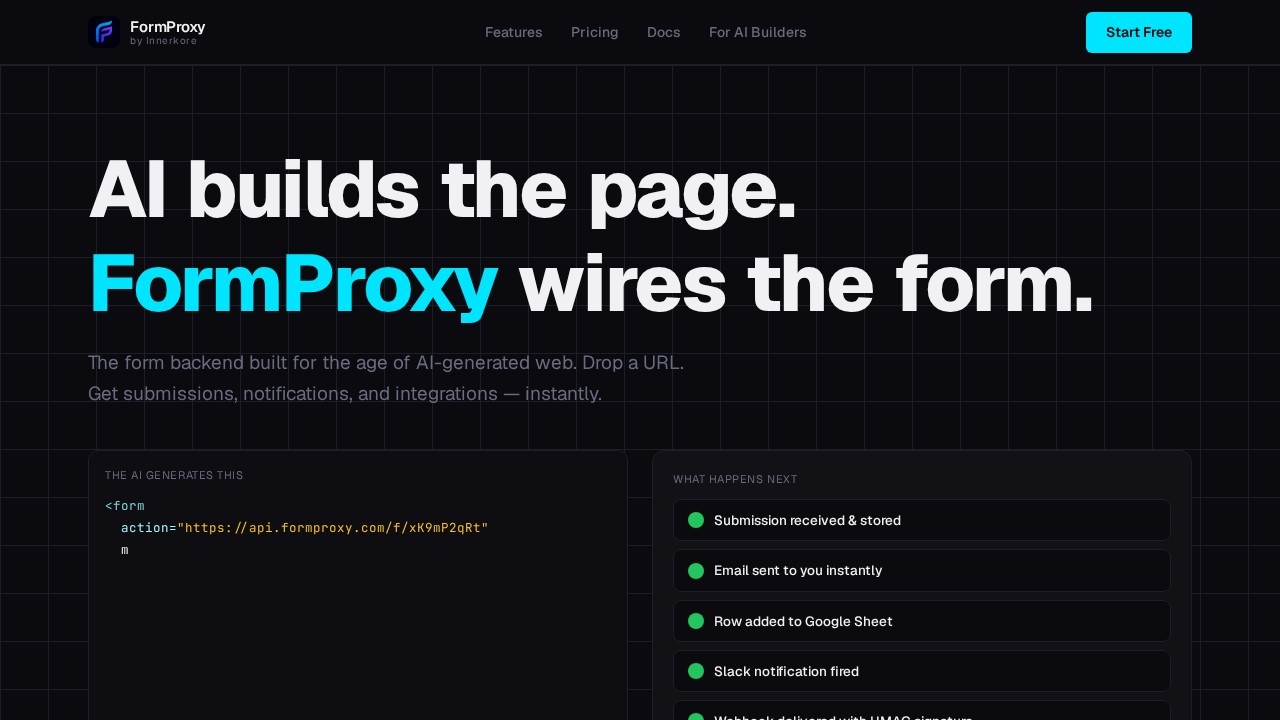
FormProxy is a form backend service designed specifically for AI-generated web pages. It lets you drop a URL and instantly get form submissions, notifications, and integrations working without any backend code. The platform provides a permanent endpoint URL that you can paste into any HTML form, and it handles routing submissions to email, Slack, Google Sheets, webhooks, or Zapier/Make workflows. It's built as an MCP skill for Claude, GPT-4, and other LLMs, allowing AI agents to create live form endpoints in a single tool call.
Application scenarios
AI-generated websites
Every form on getaipage.com or any AI-built page can route submissions to inbox, Slack, or Google Sheets with no code and setup in 2 minutes.
AI agent pipelines
Agents using Claude, GPT-4, or any LLM can call `create_form` via the MCP skill to generate real, working forms instead of placeholders.
Enterprise submission infrastructure
Plan-based quotas, HMAC-signed webhooks, dead-letter retry queues, and a full audit log handle submission volume at scale.
Multi-framework forms
Works with React Hook Form, Formik, TanStack Form, Solid.js, or any framework that can POST a form—just paste the endpoint URL.
SME form routing
Small business owners can set up forms that automatically send submissions to email, Slack, Google Sheets, or custom webhooks per form configuration.
Core Features
One-call form creation
Your AI agent creates a form with a single API call, returning a live endpoint URL immediately.
MCP skill for LLMs
Claude, GPT-4, and any LLM can use the MCP skill to call `create_form` and get a working form backend without manual setup.
Instant submission routing
Submissions appear in your dashboard instantly and can be fanned out to Slack, Google Sheets, Gmail, Zapier, Make, or webhooks—configured per form.
HMAC-signed webhooks
Every webhook delivery includes an HMAC signature for secure, verified data transmission.
Dead-letter retry queues
Failed submissions are automatically retried, ensuring no data is lost during processing.
Full audit log
Enterprise users get a complete audit trail of all form activity for compliance and debugging.
Plan-based quotas
Submission volume is managed through tiered plans, from 100 submissions per month on the Free plan up to 100,000 on the Pro plan.
No SDK or configuration required
Just drop the endpoint URL into any `<form action="">` attribute—works with AI-generated HTML, hand-coded pages, or Webflow.
Dashboard management
Create forms via the API, the dashboard, or let your AI agent use the MCP skill—all methods produce a permanent endpoint URL.
Target users
- AI builders who generate websites with getaipage.com or other AI tools and need real form functionality without backend coding.
- Enterprise teams that need reliable submission infrastructure for AI pipelines at scale, with quotas, retry queues, and audit logs.
- SME owners who want a simple, no-code way to route form submissions to their inbox, Slack, or Google Sheets in under 2 minutes.
- Developers working with React Hook Form, Formik, TanStack Form, Solid.js, or any framework that can POST form data.
How to use FormProxy?
- Create a form: Call the API, use the dashboard, or let your AI agent use the MCP skill to generate a permanent endpoint URL.
- Drop the URL anywhere: Paste the endpoint into any
- Route submissions: Submissions appear in your dashboard instantly. Configure per-form routing to Slack, Google Sheets, email, webhooks, or Zapier/Make workflows.
Pricing and free trial
FormProxy offers three plans based on monthly submission volume:
- Free: 100 submissions per month
- Starter: 10,000 submissions per month
- Pro: 100,000 submissions per month
Effect review
FormProxy solves a real pain point for anyone building AI-generated websites: getting forms to actually work without writing backend code. The MCP skill integration with Claude and GPT-4 is a standout feature, letting AI agents create live endpoints in a single call rather than generating broken placeholders. The routing to Slack, Google Sheets, and email covers the most common use cases, and the enterprise features like HMAC-signed webhooks and dead-letter queues add reliability for production workloads. For a tool that promises "drop a URL, done," it delivers exactly that—simple setup with no SDK or configuration overhead. The free tier is generous enough for testing, and the paid plans scale predictably with submission volume.
Frequently Asked Questions
What is FormProxy?
How does FormProxy work with LLMs?
What integrations does FormProxy support?
Is FormProxy free to use?
Can FormProxy handle forms from any website?
What programming languages or frameworks does FormProxy require?
FormProxy - AI Tool Detail
FormProxy by the FormProxy team wires forms instantly from any URL, delivering submissions, notifications, and integrations. Designed as an MCP skill for Claude, GPT-4, and LLMs, it streamlines form h
Category:Skill
Visit Link:https://www.formproxy.com/
Tags:form integration、MCP skill、LLM tools、web scraping、automation