
TAT Test
TAT Testによるオンラインプラットフォーム。TATカード、研究インサイト、プライバシー保護、結果の即時ダウンロードを提供。
What is TAT Test?
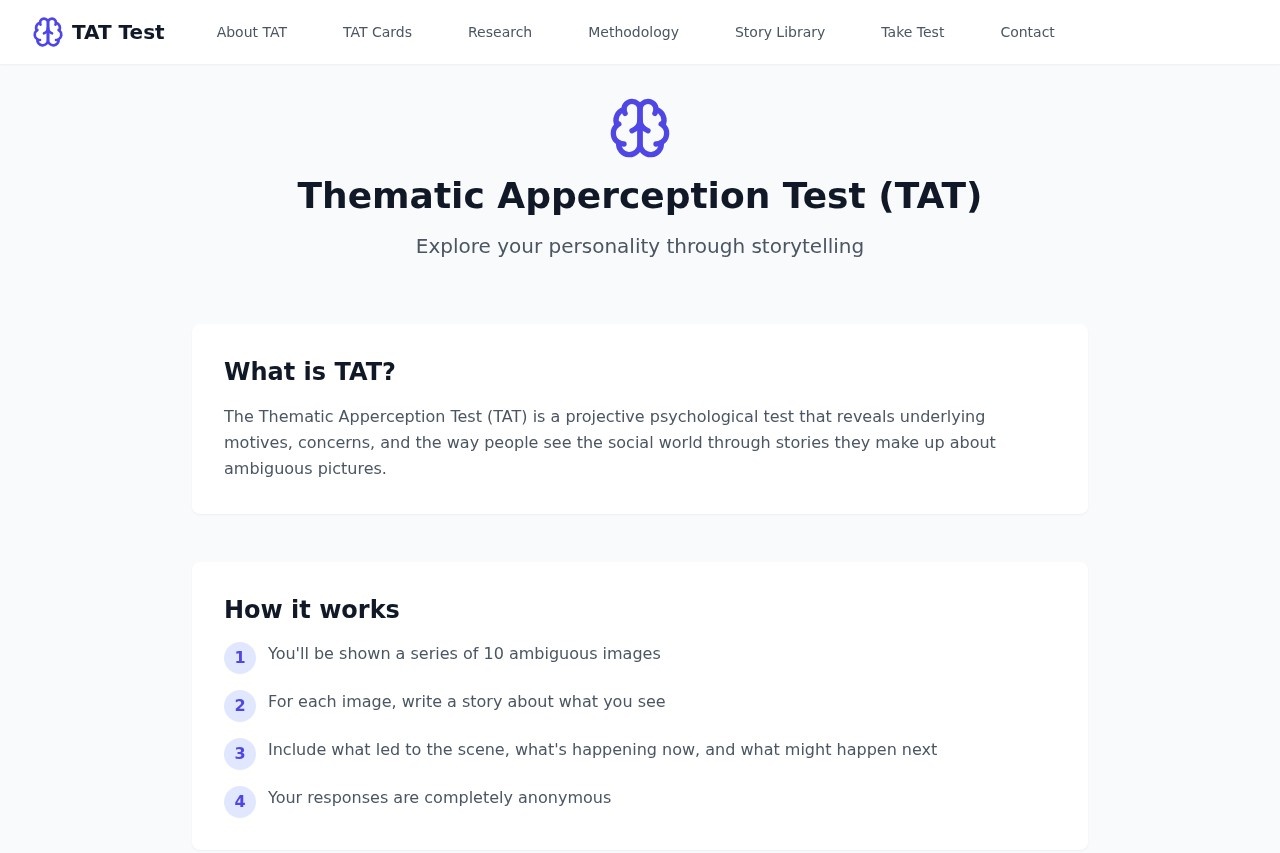
TAT Test is an online platform that lets you take the Thematic Apperception Test (TAT), a classic projective psychological assessment. You view a series of ambiguous images and write stories about them, which are then analyzed to reveal underlying motives, concerns, and social perceptions. The platform provides a transparent scoring model based on McClelland’s motivational theory, and delivers a downloadable PDF with your results. It is designed as an educational simulation, not a clinical diagnostic tool.
Application scenarios
Personal growth
Individuals can explore how their stories reveal recurring motivations and track progress with repeated assessments.
Psychology education
Students can practice interpreting narrative data without needing the full physical card set, with context and interpretation tips provided for each card.
Coaching and facilitation
Life coaches and facilitators can use the prompts to spark reflective conversations while respecting the boundaries of non-clinical work.
Classroom teaching
Educators can demonstrate projective techniques safely and ethically using anonymized data.
Therapeutic support
Users can bring their results to a counselor, coach, or therapist for deeper discussion and personalized advice.
Core Features
TAT card set
You are shown a series of 10 ambiguous images to prompt your storytelling.
Story writing prompts
For each image, you write a story covering what led to the scene, what’s happening now, and what might happen next.
Anonymous responses
Your submissions are completely anonymous, ensuring privacy.
Transparent scoring model
Each story is analyzed using McClelland’s motivational theory, with a clear, explainable scoring approach.
Downloadable PDF report
Your results are delivered as a PDF that includes a summary of achievement, affiliation, and power themes.
Emotional tone indicators
The report distinguishes positive and negative language in your writing and offers suggestions for reflection.
Guidance for professional discussion
The PDF includes advice on how to bring your results to a counselor, coach, or therapist for deeper exploration.
Educational context
Each card preview comes with background and interpretation tips to support learning.
Target users
- Students & Researchers: Psychology students and researchers who want to practice interpreting narrative data or conduct studies without needing physical TAT cards.
- Coaches & Facilitators: Life coaches and facilitators who use storytelling prompts for reflective conversations in non-clinical settings.
- Personal Growth Seekers: Individuals interested in exploring their own motivations, emotional patterns, and personality through storytelling.
- Educators: Teachers introducing projective techniques in psychology or social science classes who need a safe, ethical demonstration tool.
How to use TAT Test?
- Visit the TAT Test website at https://www.tat-test.com/.
- You will be shown a series of 10 ambiguous images one at a time.
- For each image, write a story that includes what led to the scene, what’s happening now, and what might happen next.
- Your responses are submitted anonymously.
- After completing all stories, you receive a downloadable PDF report with your analysis, including motivational themes and emotional tone indicators.
Effect review
TAT Test delivers a clean, educational simulation of a classic projective test. The transparent scoring model based on McClelland’s theory gives users concrete feedback on achievement, affiliation, and power themes, which is more actionable than vague personality descriptions. The emotional tone indicators and reflection suggestions add practical value for personal growth. However, the platform explicitly states it is not a clinical diagnostic tool, so users seeking therapy-grade assessment should consult a qualified professional. For students, coaches, and self-explorers, it offers a structured, privacy-respecting way to engage with narrative psychology. The downloadable PDF report is a useful takeaway for further discussion with a counselor or coach.
Frequently Asked Questions
TATテストとは何ですか?
TATテストはどのように機能しますか?
私のデータはプライバシーが守られますか?
結果をダウンロードできますか?
研究洞察は利用できますか?
TAT Test - AI Tool Detail
TAT Testによるオンラインプラットフォーム。TATカード、研究インサイト、プライバシー保護、結果の即時ダウンロードを提供。
Category:学習プラットフォーム
Visit Link:https://www.tat-test.com/
Tags:TATテスト、主題統覚テスト、オンライン心理テスト、AI性格診断、メンタルヘルスツール