
Wolfram Language
A comprehensive computational platform by Wolfram, featuring LLM integration, advanced symbolic and numeric computing, visualization, and specialized tools for astronomy, chemistry, and life sciences.
What is Wolfram Language?
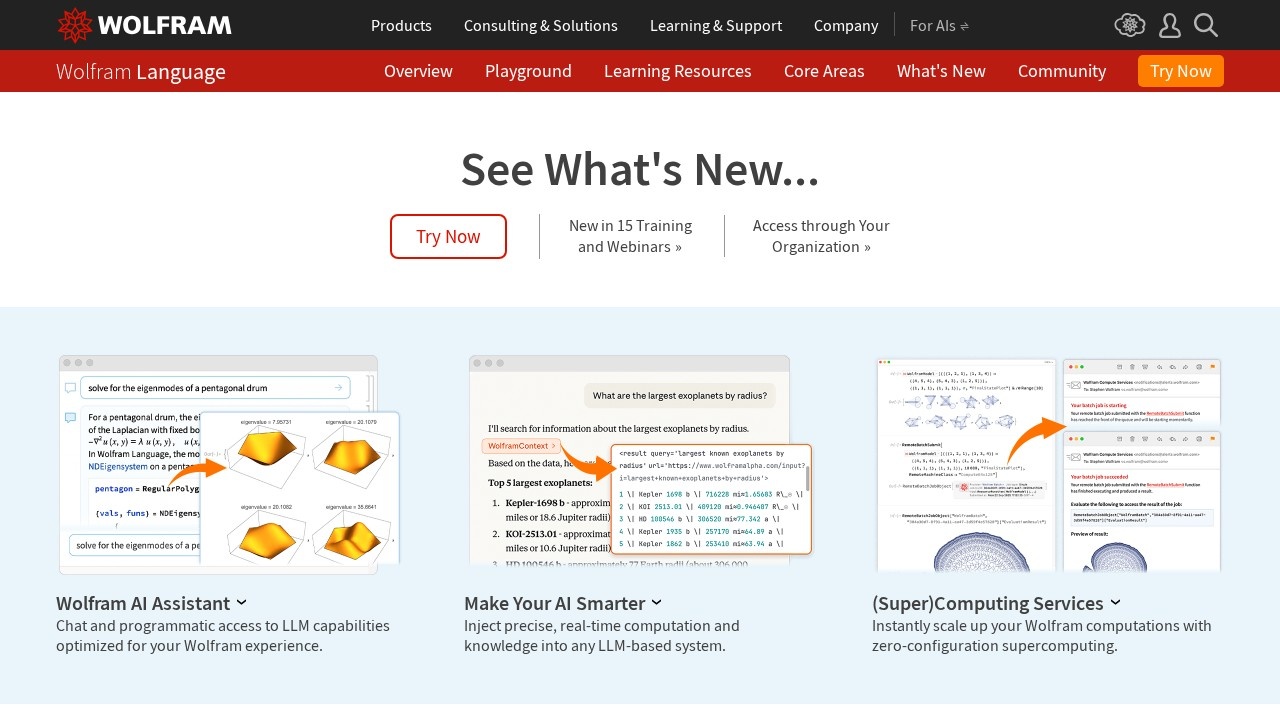
Wolfram Language is a comprehensive computational platform that integrates symbolic and numeric computing, visualization, and specialized tools for fields like astronomy, chemistry, and life sciences. It now includes LLM capabilities, enabling users to inject precise, real-time computation and knowledge into any LLM-based system. The platform also features an AI Assistant in every notebook, programmatic access to LLM functions, and zero-configuration supercomputing services. Users leverage it for everything from data analysis and system modeling to audio/video processing and user interface design.Application scenarios
Scientific research
Perform advanced symbolic and numeric computation, including noncommutative algebra, differential equations, and special functions.
Chemistry and biology
Conduct substructure searching, molecular visualization, local protein folding, and symbolic biomolecule analysis.
Astronomy and geography
Generate astronomical graphics, compute historical geography data, and create beautiful maps.
Data analysis
Work with tabular data, time series, categorical data, and date statistics using the ModelFit superfunction.
AI and LLM integration
Use the Wolfram AI Assistant Chat, vector databases, RAGs, and semantic search to make AI systems smarter with real-time computation.
Audio and video processing
Handle music, speech, building and tracking video content.
User interface and notebooks
Develop notebooks with dark mode, real-time find, notebook themes, and Markdown conversion.
Core Features
AI Assistant in every notebook
Access Wolfram’s LLM capabilities directly within your notebooks for streamlined computation and knowledge injection.
Vector databases, RAGs & semantic search
Enhance AI systems with precise, real-time computation and knowledge retrieval.
Zero-configuration supercomputing
Instantly scale up Wolfram computations with GPU support via Wolfram Compute Services.
Tabular & time series data
Work with large datasets, including time and event series, categorical data, and date statistics.
Symbolic & numeric computation
Perform noncommutative algebra, symbolic arrays, matrix operations, special functions, and differential equation solving.
Geometry, graphs & graphics
Create colored geometry, region annotations, curvature computations, geodesics, and hyperbolic graph layouts.
PDEs & system modeling
Apply PDEs to more applications, train system models, and smooth control system workflows.
Chemistry & biomolecules
Perform substructure searching, molecular visualization, local protein folding, and symbolic biomolecule analysis.
Astronomy & geography
Generate astronomical graphics, compute historical geography, and create more beautiful maps.
Audio & video
Handle music, speech, and building/tracking video content.
User interface & notebooks
Use dark mode, real-time find, notebook themes, Markdown conversion, notebook diff, and modern % syntax.
Compiler & evaluation
Compiler enhancements, incremental functions, smoother external language integration, standalone applications, structured package format, and GPU computation.
Core language
Subvalues can now be held, exceptions and error handling in large codebases, with & cyclic lists, and language tune-ups.
Target users
Researchers, data scientists, chemists, astronomers, educators, and developers who need a unified platform for symbolic and numeric computation, data analysis, AI integration, and system modeling. It’s also ideal for anyone building LLM-based systems that require precise, real-time computation and knowledge injection.How to use Wolfram Language?
To get started, visit the official Wolfram Language website and sign up for an account or download the software. Open a notebook and use the AI Assistant to chat or programmatically access LLM capabilities. You can inject real-time computation into any LLM-based system via the Wolfram Foundation Tool, MCP Cloud Service, or MCP Local Service. For large-scale tasks, use Wolfram Compute Services with zero-configuration supercomputing and GPU support. Refer to the official documentation for detailed workflows.Effect review
Wolfram Language delivers a robust, all-in-one computational environment that now seamlessly integrates with AI systems. The addition of LLM capabilities, vector databases, and supercomputing services makes it a powerful choice for researchers and developers who need both symbolic/numeric computation and modern AI tools. The platform’s breadth—from chemistry and astronomy to audio/video and user interface design—means it can replace multiple specialized tools for many users. While the learning curve may be steep for newcomers, the feature set is comprehensive and well-suited for advanced computational tasks. Overall, it’s a high-quality platform for those who need serious computation and AI integration.Frequently Asked Questions
What is Wolfram Language?
Can Wolfram Language be used for free?
What kind of computations can Wolfram Language perform?
Does Wolfram Language integrate with large language models?
How does Wolfram Language handle visualization?
Is Wolfram Language suitable for scientific research?
Wolfram Language - AI Tool Detail
A comprehensive computational platform by Wolfram, featuring LLM integration, advanced symbolic and numeric computing, visualization, and specialized tools for astronomy, chemistry, and life sciences.
Category:Programming Assistant
Visit Link:https://www.wolfram.com/language/new-in-15/
Tags:computational intelligence、LLM integration、symbolic computing、scientific computing、data visualization