
NotebookLM
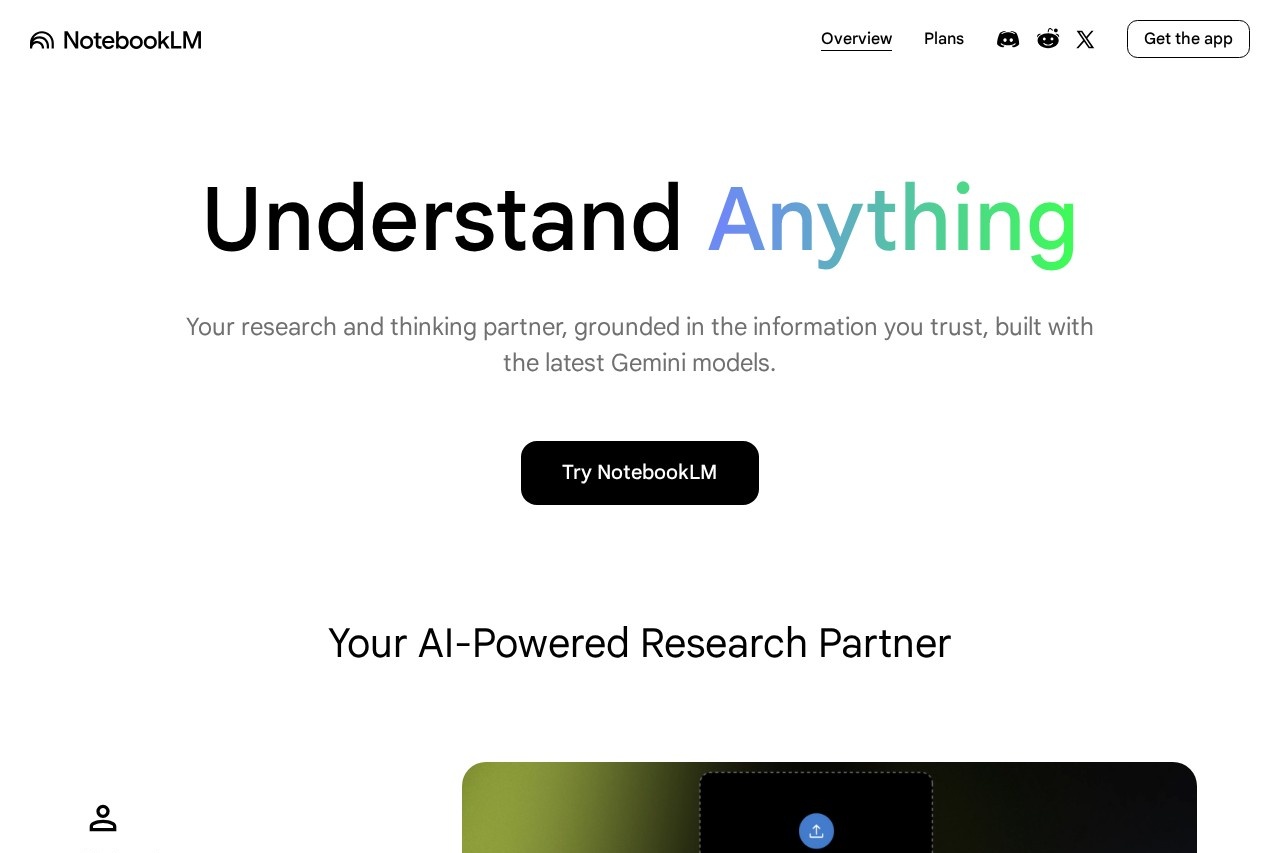
NotebookLM by Google is an AI research assistant that analyzes your sources, simplifies complex information, and helps organize ideas for clearer thinking and writing.
What is NotebookLM?
NotebookLM is an AI research assistant developed by Google. It is designed to help users analyze their own source materials and simplify complex information. The tool assists in organizing ideas to support clearer thinking and writing.Application scenarios
Academic research
Analyzing research papers, articles, and books to distill key concepts.
Content creation
Organizing notes and sources to draft articles, reports, or blog posts.
Professional analysis
Reviewing business documents, competitive intelligence, or technical reports.
Student learning
Breaking down complicated study materials into understandable summaries.
Personal knowledge management
Synthesizing information from various personal notes and documents.
Core Features
Source analysis
The AI can read and analyze documents, notes, or other source materials you provide.
Information simplification
It can break down complex topics and information into clearer, more digestible explanations.
Idea organization
The tool helps structure and connect ideas from your sources to improve thought processes.
Writing assistance
It aids in the writing process by helping to organize thoughts and information coherently.
Target users
This tool is built for individuals and professionals who work heavily with information. Primary users include researchers, students, writers, analysts, and anyone who needs to process, understand, and synthesize content from multiple documents for their work or studies.How to use NotebookLM?
You can access NotebookLM by visiting its official website. The core workflow involves providing the AI with your own source documents, after which you can interact with it to ask questions, get summaries, and organize the information for your projects.Effect review
As an AI research assistant from Google, NotebookLM positions itself as a dedicated thinking partner for knowledge work. Its focused feature set on analyzing user-provided sources suggests a practical application for reducing the cognitive load of processing dense information. The tool’s utility is directly tied to the quality and relevance of the source materials a user supplies, making it a potentially powerful adjunct for research and writing tasks rather than a general-purpose chatbot. For users dealing with complex documents regularly, it offers a structured approach to moving from information collection to organized insight.Frequently Asked Questions
What is NotebookLM?
How does NotebookLM work?
Is NotebookLM free to use?
What types of sources can I upload?
Can NotebookLM help with writing?
Is my data private with NotebookLM?
NotebookLM - AI Tool Detail
NotebookLM by Google is an AI research assistant that analyzes your sources, simplifies complex information, and helps organize ideas for clearer thinking and writing.
Category:Personal Assistant
Visit Link:https://notebooklm.google/
Tags:AI research assistant、information analysis、writing aid、idea organization、Google AI