AI Infrastructure2026-11-23 NVIDIA AI Blog
NVIDIA DGX Spark Kit Creates Desktop HPC Lab
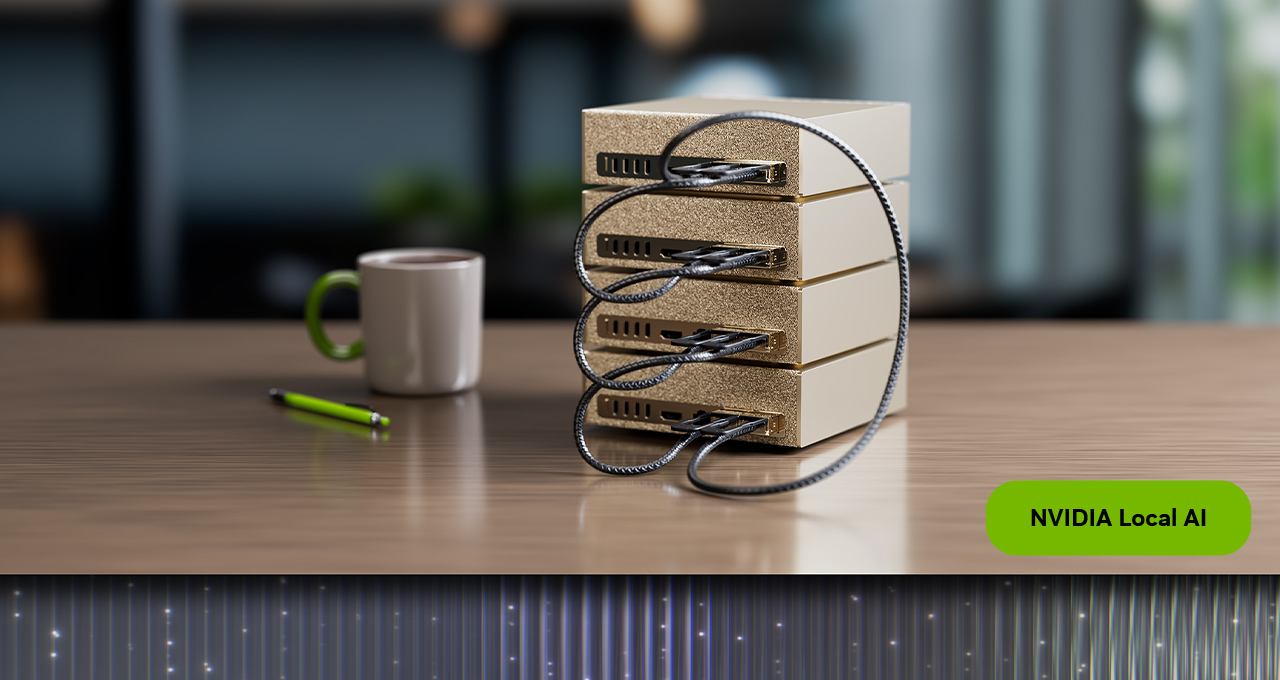
At SC26, NVIDIA introduced the DGX Spark HPC Developer Kit, a compact system aimed at researchers, academics, and developers who want to prototype high-performance computing and AI workloads without reserving time on a large shared cluster. The kit is built from four DGX Spark nodes. Each node connects directly to its two neighbors in a ring topology, creating a small cluster that can sit on or near a desk.
The concept is a desktop supercomputing lab. Traditional HPC development often depends on access to institutional clusters that are powerful but busy, complex, and shared across many users. A small dedicated cluster gives developers a place to test code, tune performance, and experiment with distributed workloads before moving to larger systems. The ring connection is a simple design choice that lets the nodes communicate directly with adjacent nodes, which may be useful for teaching interconnect concepts and for early-stage prototyping.
NVIDIA is targeting teaching and research as well as industrial experimentation. For universities, the kit could provide a hands-on way to demonstrate parallel programming, distributed AI, and HPC workflows. For developers, it could shorten the feedback loop between writing code and seeing how it behaves across multiple nodes. For researchers, it could offer a controlled environment for testing ideas that might later scale to bigger infrastructure.
The kit does not replace a full data center. Four desktop nodes cannot match the memory, networking, or scale of a major HPC installation. Its value is in accessibility and iteration. By packaging multiple nodes in a desktop-friendly format, NVIDIA is trying to lower the barrier to experimenting with cluster-style computing and AI workloads. The announcement fits a wider trend toward bringing AI and HPC development closer to the individual user, while still leaving room for larger systems when projects outgrow the desk-sized lab.