
Xueshucha
Xueshucha by Youdao uses DeepSeek and proprietary models to detect AI-generated content and reduce plagiarism and AI similarity in academic documents to under 10%.
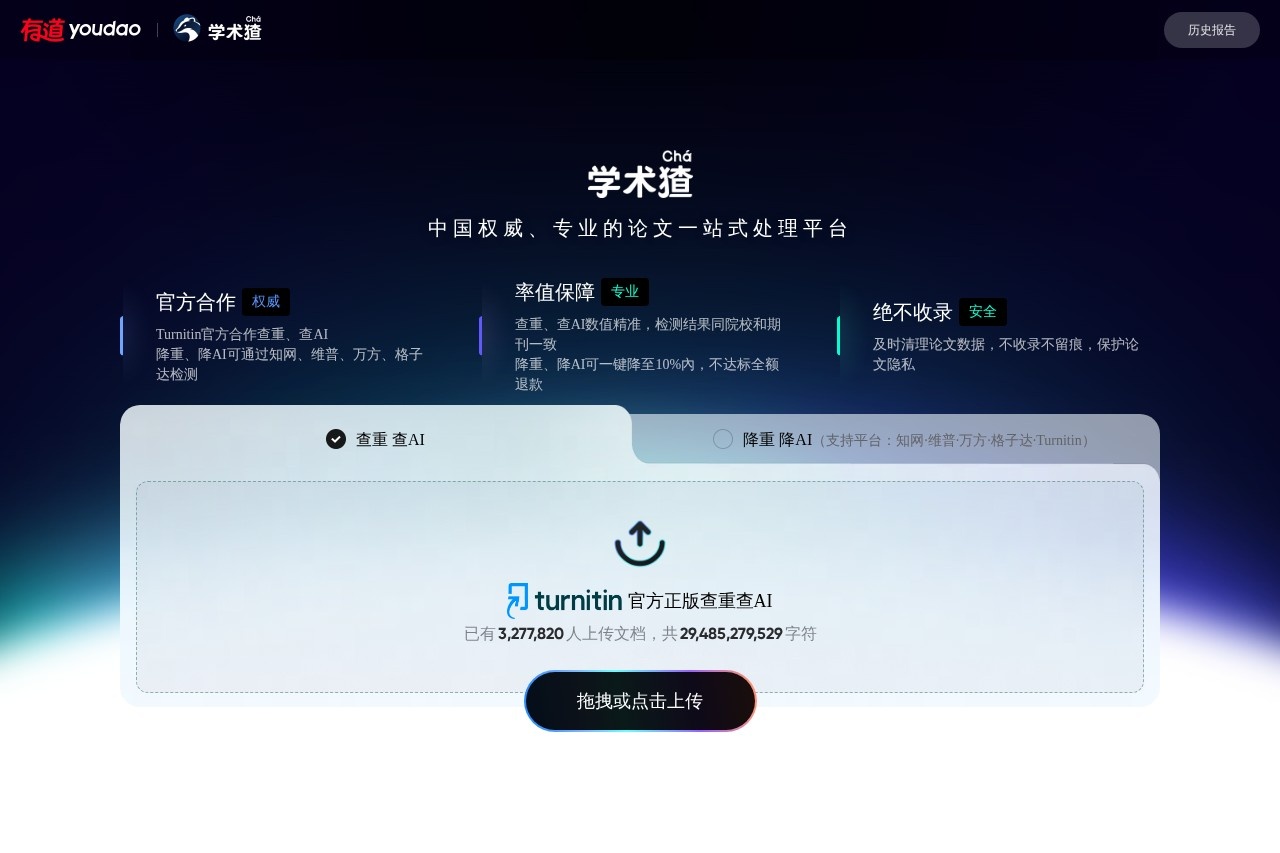
What is Xueshucha?
Xueshucha is a professional, all-in-one academic paper processing platform from Youdao. It is designed to detect AI-generated content and plagiarism, and to reduce similarity scores in academic documents. The platform leverages DeepSeek and proprietary models to help users bring AI similarity and plagiarism rates under 10%. It is positioned as an authoritative tool with official partnerships for academic verification.Application scenarios
Academic paper submission
Students and researchers can check and adjust their papers to meet the strict originality requirements of universities and journals.
Thesis and dissertation preparation
Authors can ensure their work passes institutional plagiarism and AI-content checks before final submission.
Journal manuscript review
Researchers can pre-screen manuscripts to align with the detection standards of international publications like SCI or Nature.
Multi-platform compliance
Users can prepare a single document to meet the specific detection criteria of different Chinese platforms like CNKI and Weipu, as well as Turnitin.
Language-specific verification
Non-English papers, such as those in Japanese or Spanish, can be checked for originality using the platform's international database.
Core Features
AI and plagiarism detection
The platform provides official Turnitin-based checking for both plagiarism and AI-generated content.
One-click reduction
Users can automatically reduce plagiarism and AI similarity rates to below 10% with a single action.
Multi-platform support
The reduction service is compatible with major Chinese academic databases (CNKI, Weipu, Wanfang, Gezida) and Turnitin.
Authoritative result matching
Detection results are calibrated to match those from universities and academic journals.
Format and batch upload
The service supports docx, doc, pdf, and txt formats, allowing uploads of up to five files at once.
Data privacy and security
The platform promptly clears paper data after processing, promising no storage or traces to protect user privacy.
Extensive database
The system is built on a database covering 120 million core Chinese and international journal papers.
Specialized terminology
It utilizes a proprietary terminology database spanning over 500 academic disciplines.
Advanced model technology
The service employs a self-developed academic semantic parsing engine backed by six natural language processing patents.
Target users
This tool primarily serves students, academic researchers, and authors preparing theses, dissertations, or manuscripts for submission. It is targeted at users who need to pass stringent originality checks from educational institutions (like Harvard, Stanford, Tsinghua) or academic publishers (like IEEE, Springer, Nature). It is particularly relevant for those submitting to both Chinese and international academic systems.How to use Xueshucha?
Visit the official website and use the upload area to drag, drop, or select your document. The platform accepts docx, doc, pdf, and txt files. You can upload up to five files at once. After uploading, you can access detection and reduction services. For detailed steps on running reports and using the reduction tools, users should refer to the official platform interface.Effect review
The platform makes strong claims about its effectiveness, backed by its institutional partnerships. It guarantees that its reduction service can bring similarity rates below 10%, offering a full refund if this target is not met. The site states that its AIGC trace removal rate reaches 92.3% and that processed papers will pass detection on specified authoritative platforms. Given its direct integration with Turnitin and major Chinese databases, the tool is positioned to deliver results that directly align with the checks performed by academic institutions, which is its core value proposition for users under publication pressure.Frequently Asked Questions
What is Xueshucha?
How does Xueshucha detect AI-generated content?
What percentage of AI similarity can Xueshucha achieve?
Is Xueshucha specifically for academic documents?
What models does Xueshucha use?
Who developed Xueshucha?
Xueshucha - AI Tool Detail
Xueshucha by Youdao uses DeepSeek and proprietary models to detect AI-generated content and reduce plagiarism and AI similarity in academic documents to under 10%.
Category:AI 內容偵測
Visit Link:https://xueshucha.youdao.com/
Tags:AI detection、plagiarism checker、academic writing、content similarity、AI-generated content